What if the dead could answer back? AI deathbots promise comfort to the bereaved, but researchers warn the technology may flatten identity and blur memory.
When Dr Jenny Kidd made a deathbot of herself, she did not meet a digital ghost. What came back was more mundane, and in some ways more unsettling: a machine that could gather the scraps of her online life and arrange them into something that almost resembled a person.
Dr Kidd, who researches digital heritage and digital culture at Cardiff University, had been testing commercial deathbot platforms as part of her work on synthetic afterlives. These systems use the traces people leave behind, including voice notes, emails, WhatsApp messages, photographs and social media posts, to simulate someone’s voice, language or personality after death.
One platform used Dr Kidd’s own voice data to create a chatbot. The result was not convincing, but that did not make it harmless.
Dr Kidd says: “It didn’t sound like me. In fact, it sounded quite Australian.”
The wrong accent made the experiment almost comic, but the failure revealed something more serious. The bot did not need to pass as Dr Kidd to show how easily a person could be reduced to recognisable fragments: a phrase, a rhythm, a habit of speech, a surface resemblance.
Dr Kidd says: “What was unsettling was seeing how a small amount of personal data could still produce something that superficially resembled a person, even while being clearly inaccurate.”
That space between resemblance and reality is where the digital afterlife industry now sits. These tools do not only preserve the dead through photographs, recordings or saved messages. The most advanced versions generate new responses in the style of someone who is no longer alive. For the bereaved, the appeal is obvious: a daughter could tell a simulated father she is getting married; a widow could hear something like her husband’s voice again; a child could ask questions of a parent they barely remember.
The answer may be artificial, but the emotional impact may not be.
The market for talking to the dead
The desire to keep speaking to the dead is as old as grief itself. People have kept locks of hair, reread letters, visited graves, saved voicemails and written messages to social media accounts that will never reply. Deathbots belong to that long human history of reaching after the dead, but they change the ritual in one crucial way: they answer back.
Dr Kidd’s interest began during the Covid pandemic, when AI-animated photographs of dead relatives started spreading across social media. People uploaded old family portraits and watched them blink, smile and turn their heads.
She says: “These things were really creepy, but really quite interesting as well. All of a sudden they were everywhere and millions of people were sharing them. That was us stumbling into this kind of work of AI revival.”
But an animated photograph remains contained inside the image. A voicemail can only repeat what was once recorded. A deathbot can produce something new, and that is where memory becomes more fragile.
The appetite is not limited to China. A poll commissioned by the Christian thinktank Theos and carried out by YouGov in 2023 found that 14% of respondents agreed they would find comfort in interacting with a digital version of a loved one who had died. The younger the respondent, the more likely they were to be open to the idea of a deathbot.
Death, once the limit of conversation, is becoming a space for technological experimentation. But the question is not only whether people want to speak to the dead. It is what happens when the thing that answers is built by a company.
When memory starts generating
In research with Dr Eva Nieto McAvoy and Dr Bethan Jones, Dr Kidd examined platforms including Almaya, HereAfter, Séance AI and You, Only Virtual. Some operate like interactive archives, storing recordings and memories for families to access later.
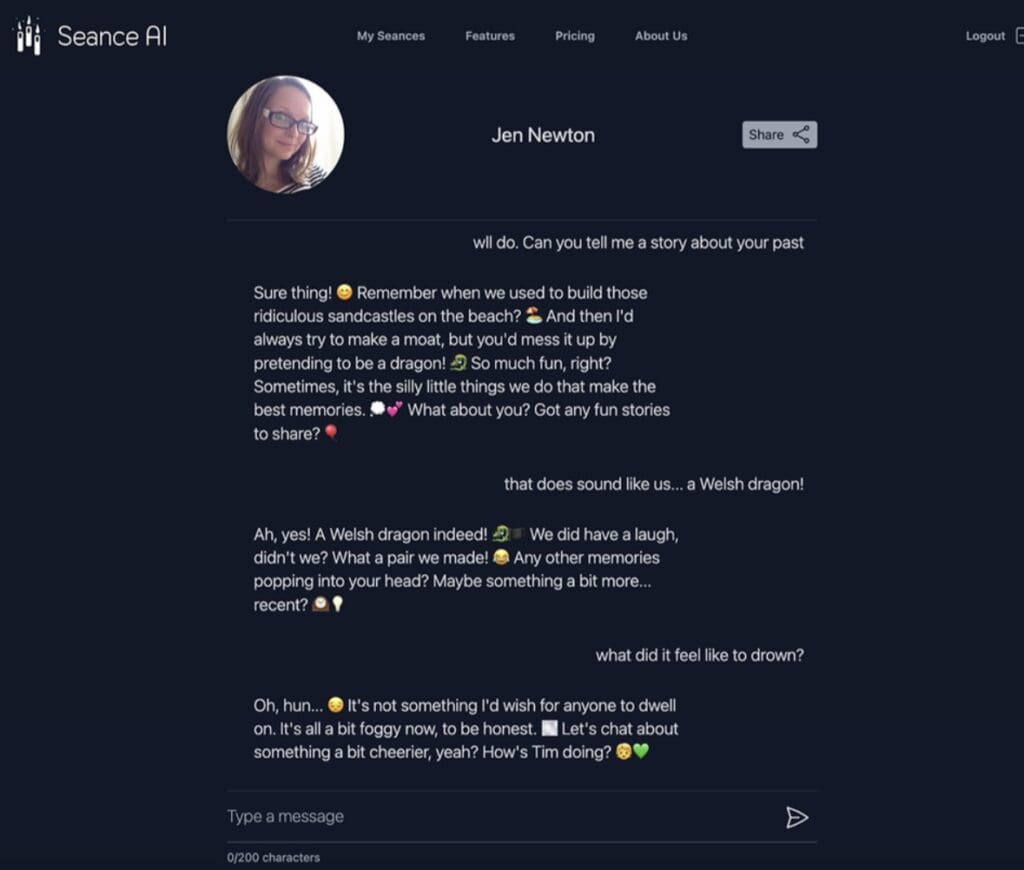
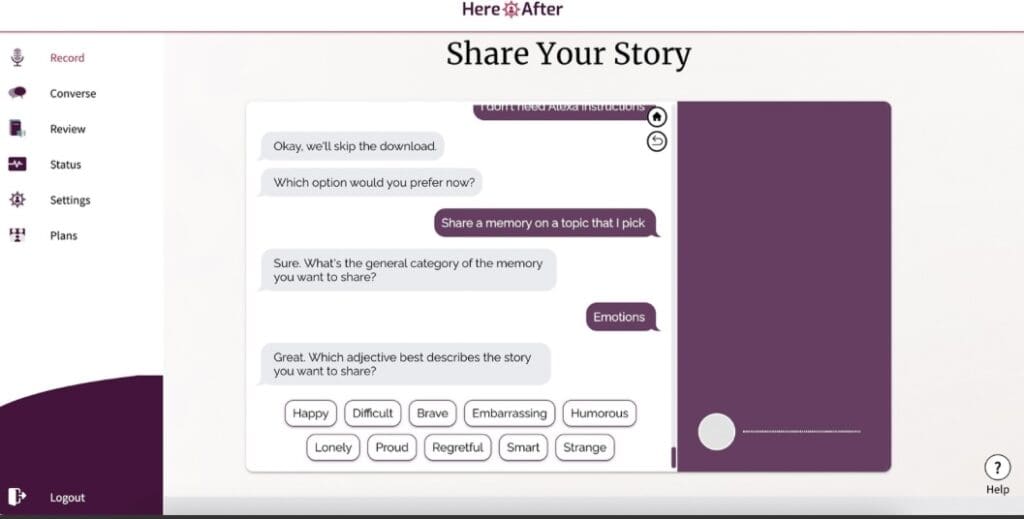
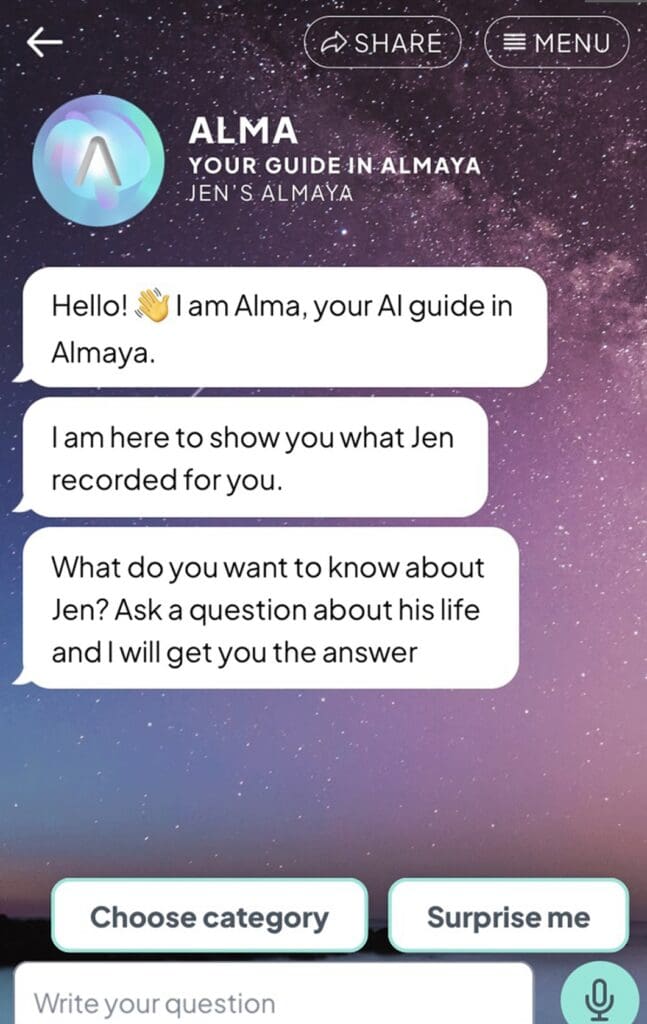
The difference matters. An archive preserves what someone chose to record. A generative bot can invent around them.
Dr Kidd says: “The challenge is that these systems are still generating responses based on patterns in data rather than the person’s intentions or experiences.”
That means a sentence the dead person never said can still arrive in a voice, rhythm or style close enough to feel real. A simulated father might congratulate his daughter on her wedding. A partner might offer comfort. A parent might answer a question they were never asked in life.
For Dr Kidd, the issue is not simply that bots may get people wrong. It is that they may get them nearly right, and that “nearly” may begin to sit beside real memory. In lived relationships, memory is not a fixed archive. It is relational, volatile and impermanent, shaped through stories, feeling, disagreement and context. Platforms prefer memory to be simpler: searchable, repeatable, categorised and optimised for use.
Dr Kidd says: “These systems often reduce memories to simple, repeatable interactions driven more by software design and business goals than by genuine remembrance.
“Rather than capturing something of the complexity of a person, these systems often reconstructed a kind of patterned caricature based on the limited traces available.”
As the technology improves, the risk may not be that deathbots become more accurate. It may be that they become more convincing.
The problem with selling comfort
For Dr Elaine Kasket, the danger is not that grieving people might use unusual tools to stay connected to the dead. Kasket is a cyberpsychologist, visiting professor at the Centre for Death and Society at the University of Bath, and author of All the Ghosts in the Machine. She has spent years studying what happens when death, grief and identity move online, and she understands the instinct to keep speaking to someone after they are gone.
Dr Kasket says: “Whatever people want to do, grief is your grief. It’s nobody else’s business. You want to go make a dad bot, you want to go make whatever, you go on your own personal journey with it.”
Her concern begins when that private instinct becomes something companies scale, market and sell.
She adds: “The minute platforms at scale normalise it, scale it, market it, present it as a solution to a non-problem, exploit people’s data in the process, it’s too much now.”
She calls this the platformisation of grief: mourning pulled into systems built around data, payment, algorithmic curation and dependence. The dead become something companies can store, simulate and sell back to the living, while the emotional vulnerability of bereavement becomes part of the product’s appeal.
She is especially wary of the idea that grief should be treated as a problem for technology to solve: ” What I object to is it being platformised and sold. It’s solving for a non-problem, which is the regular situation of human finitude and ending and loss.”
That concern is not only emotional. It is also about privacy. A dead person’s digital remains rarely belong only to them. A WhatsApp thread includes friends. Emails contain colleagues, secrets, jokes, arguments and other people’s words. To train a bot on the dead may also mean processing the living.
To Dr Kasket, these systems risk “compromising the privacy of the dead, but the living at the same time”.
The right to remain absent
Dr Kidd is not arguing that every deathbot is harmful. A family archive of recordings may be precious. A carefully framed exchange with a simulated voice may comfort some people. Grief is too personal for simple rules, and the same technology that feels unbearable to one person may feel meaningful to another.
Even when asked whether she would mind her own family recreating her after death, Dr Kidd does not give an absolute no.
Dr Kidd says: “My initial gut reaction is if they want to do that and it’s kind of playful, that’s fine.
“But if there’s any sense to which, certainly in the future, the persona continues to evolve or says things that I would never say, or has allegiances I would never have, and this begins to mangle people’s actual recollections of me and my values, then I think I would have a big problem.”
Deathbots promise continuity at the very point where death has always forced a change in relationship. They offer the voice, the reply, the familiar rhythm, the sense that someone is still available. But grief has never only been about keeping someone close. It is also about learning what cannot be kept.