
A different kind of goodbye
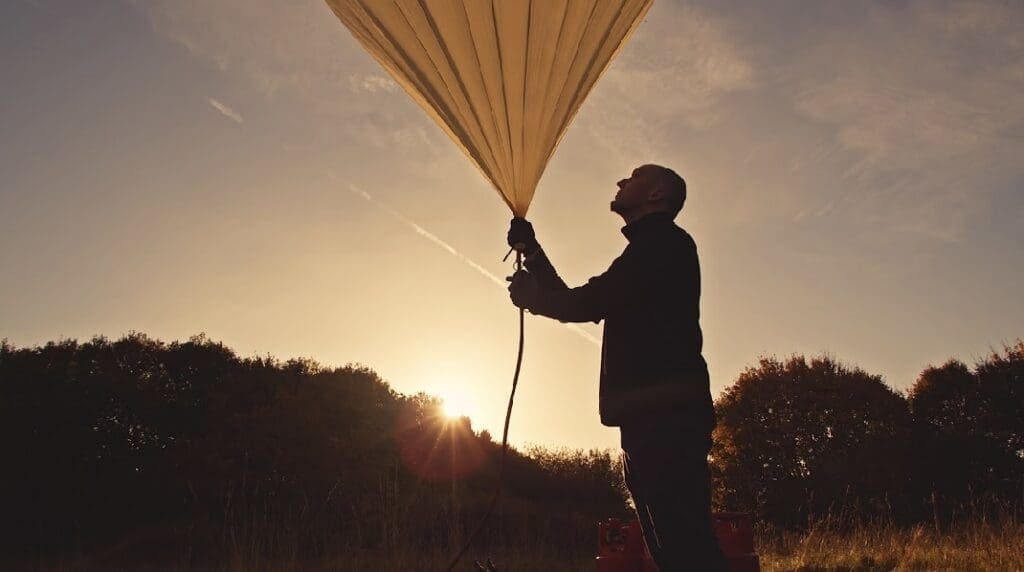
From an industrial estate in Sheffield, a huge white balloon rises into the sky carrying a sealed vessel, two cameras and someone’s ashes.
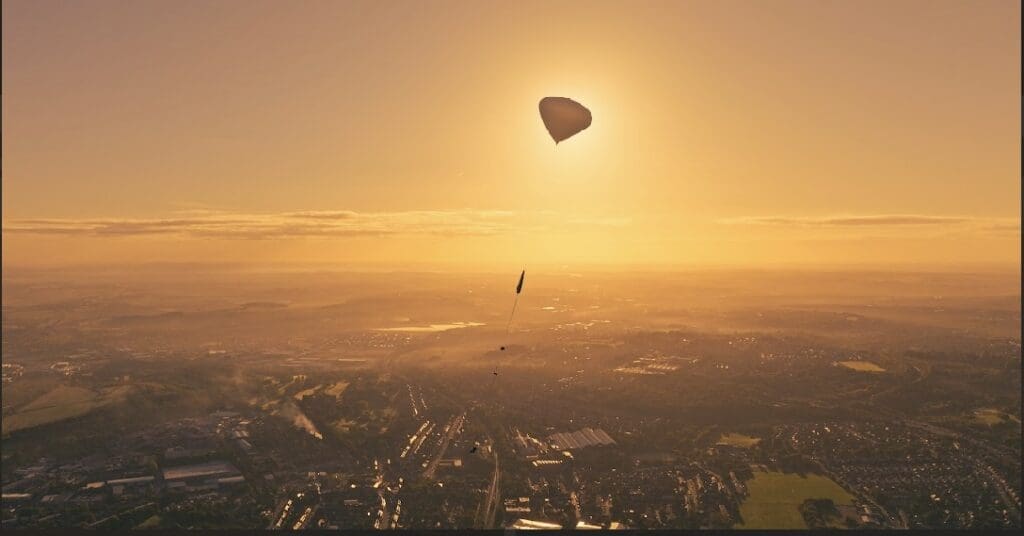
There is no chapel. No procession. No fixed place to visit afterwards. Just a slow ascent through thinning air, until the horizon curves and the Earth falls away beneath it.
At around 100,000ft, the vessel opens. The ashes are released into the stratosphere, caught by high-altitude winds and carried far beyond the point of release. Aura Flights says they can later return to Earth through rain or snow, as particles help water vapour condense and freeze in clouds.
For the families who choose it, that is the appeal. Their loved one is not left in one place.
Samantha says: “It’s very different to scattering the ashes of your dearly loved one in a park where you spent your happiest moments. But it means there will always be a part of them wherever you are. You can think of them whenever you gaze up at space.”
Why families choose it
Aura Flights began in 2014, after its founders experienced a bereavement and began asking what else might be possible. Since 2017, the company has been carrying ashes to the stratosphere and back by high-altitude balloon.
For some families, the draw is obvious. Their loved one adored space, travel, science fiction or the sky. For others, it is less about space itself and more about refusing the idea of one final resting place.
One launch carried the ashes of a father and son together. The father had been a pilot. His son had just begun studying aerospace engineering before dying unexpectedly. Another carried a young girl who had spent much of her life too unwell to travel, but had loved space. In another case, two brothers, both musicians, were sent together after their ashes had been kept by family for more than a decade.
Samantha says: “We can comingle ashes if the family requests that. A couple. A parent and child. Even a person and a pet. They go on that journey together.”
The reasons differ, but the instinct is similar. Some people do not want a grave, an urn or a single patch of ground. They want movement.
Samantha says: “We speak to people that are fanatics of space, or fanatics of Star Wars or perhaps Star Trek, or they love astrology, or they love science. But we also talk to people that just love to travel.”
How the launch works
A space scattering is not just a balloon and a box of ashes.
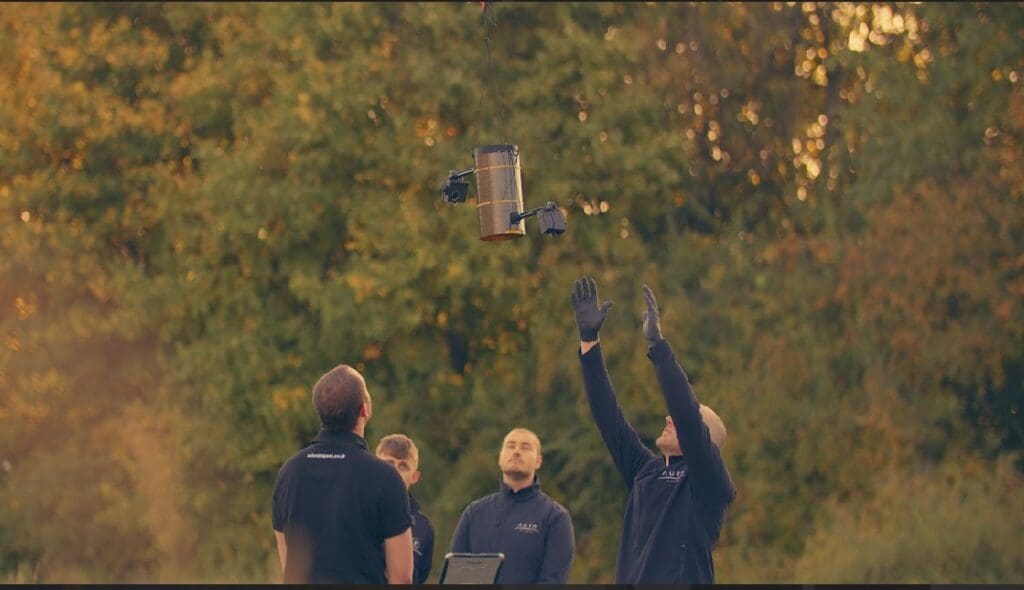
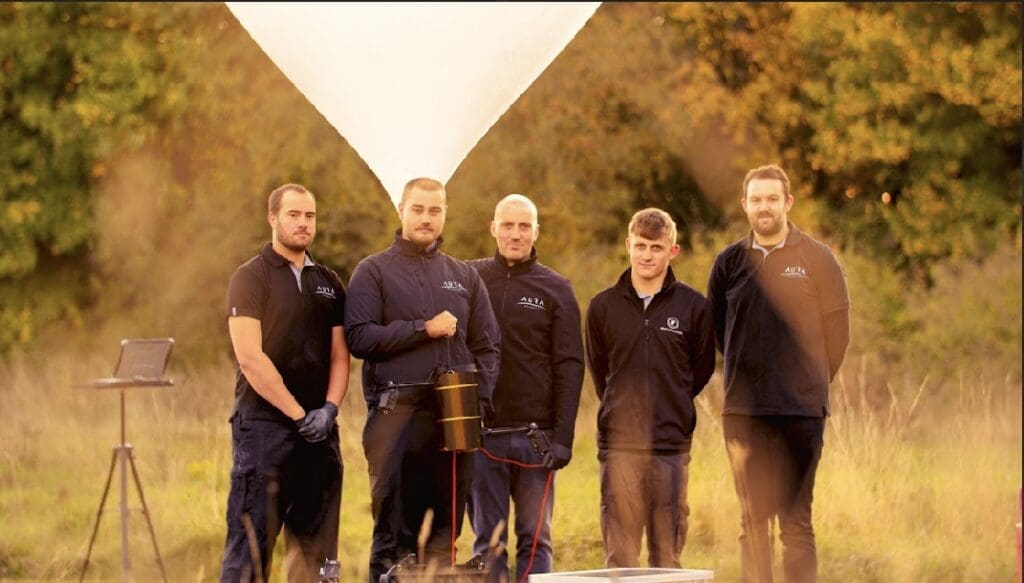
The ashes are sealed inside what Aura Flights calls an intelligent scatter vessel. It is lifted by a hydrogen balloon, tracked by GPS and monitored by a flight computer. Two camera systems record the ascent and the moment of release in 4K video.
Launches are planned around weather conditions. Flight paths are modelled before take-off. Once the balloon is airborne, the team tracks it continuously.
The balloon rises at around five metres per second. As the pressure drops, it expands, eventually growing to more than 20 metres wide. At around 32,500 metres, the vessel opens and releases the ashes in a controlled cascade.
Then the balloon bursts. The craft parachutes back to Earth. Recovery teams follow its descent to collect the vessel, cameras and equipment.
Samantha says: “We know before we’ve even released the launch craft where it will ultimately come back down. That’s really important. We reuse and recycle all of our vessels. Everything that we send up comes back down apart from the ashes.”
Grief meets engineering
The strange power of the service is that it sits between two completely different worlds: aerospace engineering and grief.
Samantha says: “The technology in and of itself is absolute. It is cold. It is resilient. It is unemotional. And at the other end of the scale, we have the passengers’ families, who are going through something very personal. We sit in that space in between.”
That space is where the memorial is made. A flight computer opens the vessel. Cameras record the release. Weather modelling decides when the launch can happen. But the final product is intimate: a film of the journey, set to music chosen by the family, with photographs, messages and footage from the ascent.
Some families also choose to attach a portrait to the outside of the vessel, so the person’s image is visible during the flight. Afterwards, the photograph is returned in a custom frame, engraved with the passenger’s name and flight details.
It is high-tech, but not impersonal. The machine becomes part of the ritual.
Why this fits a changing funeral landscape
Cremation is already the backdrop to most British funerals, with FBCA figures showing that 83% of deaths in England and Wales ended in cremation in 2024. That helps explain why ashes memorials are becoming such a visible space for personal choice.
Funeral choices in the UK are also becoming less traditional. SunLife’s 2026 Cost of Dying Report says direct cremation now makes up 21% of funerals, while 86% of direct cremation organisers still hold a memorial or celebration of life afterwards.l.
The 2021 Census found, for the first time, that less than half of people in England and Wales described themselves as Christian, while “No religion” increased. As religious identity changes, so do the rituals people choose around death.
Samantha says Aura Flights has seen that change directly, with a 300 per cent growth in applications between 2021 and 2022, and more than 150 launches taking place in a single year.
What about the environment?
Aura Flights says environmental impact is built into the design. The company says its balloons are made from biodegradable latex, its vessels are recovered and reused, and the ashes are released below the altitude of orbiting satellites.
Samantha says the service does not contribute to space junk because the vessel returns to Earth.
The environmental claim is part of the appeal, but so is the symbolism. The ashes do not remain in orbit. They are not left as debris. They are released into weather systems and, eventually, return to Earth.
The comfort of no fixed place
What Aura Flights offers is not only space. It is scale.
For some families, a grave is comforting because it gives grief somewhere to go. For others, one fixed place feels too small. Space scattering offers a different idea: that a person can be remembered through movement, weather and sky.
Each launch ends with the same image. A vessel opens above the curve of the Earth. Ashes fall in a pale stream. The planet sits blue beneath them.
Then they are gone.
Not vanished. Unplaceable.
For the families watching, that can be the comfort. Their loved one is not only in an urn, a cemetery or a mantelpiece. They are in the rain, the snow, the sky, and the next time someone looks up.