The passage from life to death is the most defining and terrifying journey of our lives. A journey which can be extremely hard to understand, and even harder to surrender to. Music-thanatologists offer us a form of music made to ease the mind, body and soul before we go.
Distressed and agitated, an old man turns restlessly in his hospital bed. His mind and body struggles to stay still as he battles ferociously with the fact that very shortly he will pass away. The nurses in the ward are visibly concerned, watching a patient they have cared for for so long slowly die in anguish. Then a man walks in. Equipped only with a levered harp, he sits bedside to the old man. Grabbing the old man’s hand with one hand and elegantly plucking harp strings with the other. The old man stops fidgeting. He slowly begins to turn towards the harp, shuffling as close as he can to it, almost in an effort to wrap himself around the instrument. Gradually, as the music is played, the old man at the edge of his bed, begins to lay completely still, satisfied with and accepting of what will happen. The harpist sits humbly with him, comforting the old man as he gracefully dies in peace.
This is one of many real life cases where music-thanatology has helped to quell the anxieties and suffering of an individual who is passing away. It is a relatively new venture in palliative care that hopes to one day extend its teaching to the entire world.
Music-thantology was created just over 50 years ago by the founder of music-thanatology Therese Shrodder-Shecker. A professionally trained harpist and singer who decided to combine both of her musical talents at the bedside of those who were fastly approaching the end of their lives to try to ease their physical, mental and spiritual pain.
Jane Franz, Executive Director of the Accorda Music-Thanatology institute, a professionally licensed music-thanatology School in Oregon, USA, said: “Music-Thanatology is a sub-speciality of palliative care, so we complement everything that palliative care does, for example when a patient is in distress, be it contractable pain, agitation, emotional or spiritual anxiety and palliative care comes in to do what they need to do which could be administering medication etc, music-thanatology is present alongside that to enhance what they can do. “It’s very often that this music can actually help people find a place of calm or comfort amidst all of the things that are going on during this time. We even see such things as pain reduction, restfulness and a lack of anxiety that comes whilst the music is present.”
Music-Thanatologists use a technique called “Phenomenological Observation” where they pay close attention to the patient and their environment, then prescriptively utilise the harp and their voice with an aim to reduce the suffering visible. Ms Franz adds: “By using what as we Music-Thanatologists call phenomenological observation, I observe the patient, and the family, or whoever’s present. I observe their vital signs, their respirations, their heart rate, either by touching their radial pulse or looking at a monitor. I observe their facial expressions: are they frowning in pain? Are they calm? Are they asleep? I see what’s going on in the room. Is there distress? Are people arguing? Are people crying?”
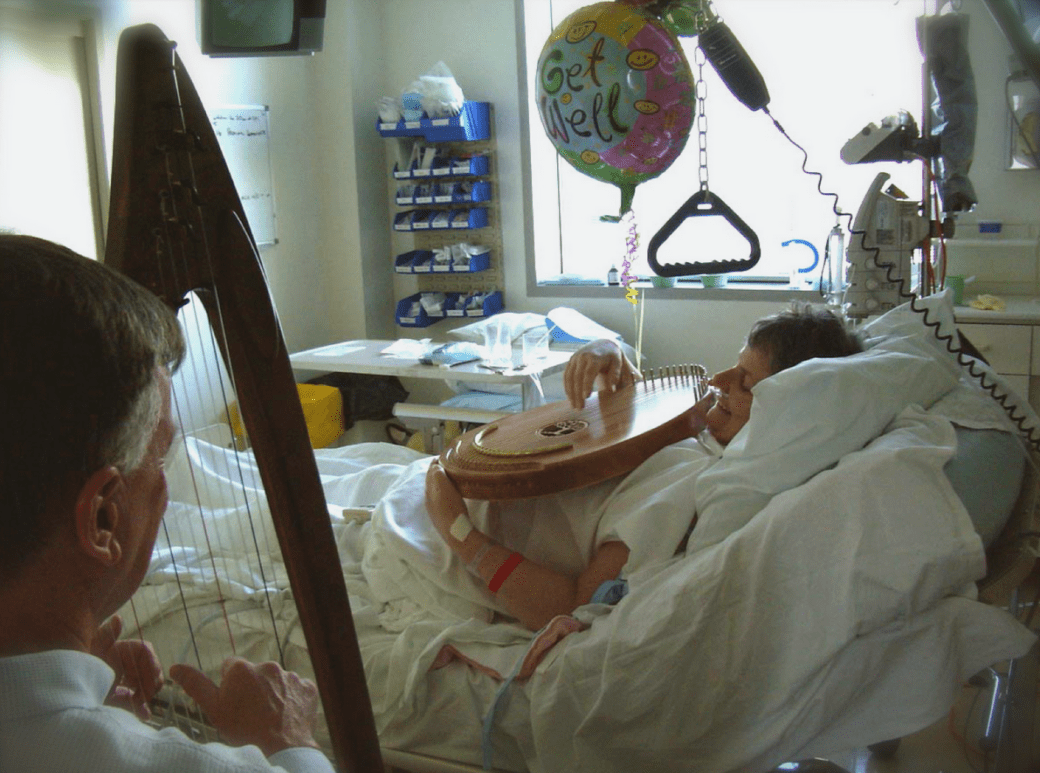
Photo credit: Peter Roberts.
“Based on what I observe, I choose different elements of music. I might choose a minor delivery or a major delivery. For example, there might be a patient who is obviously having respiratory problems. They’re breathing very fast, very shallow, it’s obviously uncomfortable for them. They look frightened by it. The family is distressed by it. I have to think where should I start. Should I offer something calming and cooling? Minor tonalities tend to have that, or do I want to offer something more stable with a structure, or do I want to use a piece of gregorian chant, which is arrhythmic, allowing me to follow the patient’s breath with it.”
So, what are the studied effects of music thanatology? In 2007, Deakin University Professor Emeritus Dr Helen Cox, alongside Australian music-thanatologist and owner of Robert’s Music Reverie Harps, Peter Roberts, conducted a study on 6 patients receiving Music-Thanatology vigils over a period of nine months. For this study, Dr Cox made note of her own personal observations as well as interviewing the patients receiving music-thanatology, their family and friends and the nurses present.
Talking about her experience being present for these vigils, Dr Cox said: “Whenever I was with Peter in a vigil, every single time he was totally focused, he was totally present. He was probably the only person in the room for whom death was absolutely fine. He wasn’t afraid of it, he didn’t wish it away for the person that he was playing for, he just accepted death as inevitable.
“The vigils we attended were not for people early in their dying stage but close to dying, the families were very frightened, there were so many times where we’d go into a room and the family would be sitting around the edges of the room because they didn’t know how to act around someone dying. And Peter would go and put the harp right up against the bedside, and you would see slowly people coming from the borders of the room, and coming closer to the bed, and being there for that person. He role modelled for them what is was like to be in the presence of dying and not be frightened.”
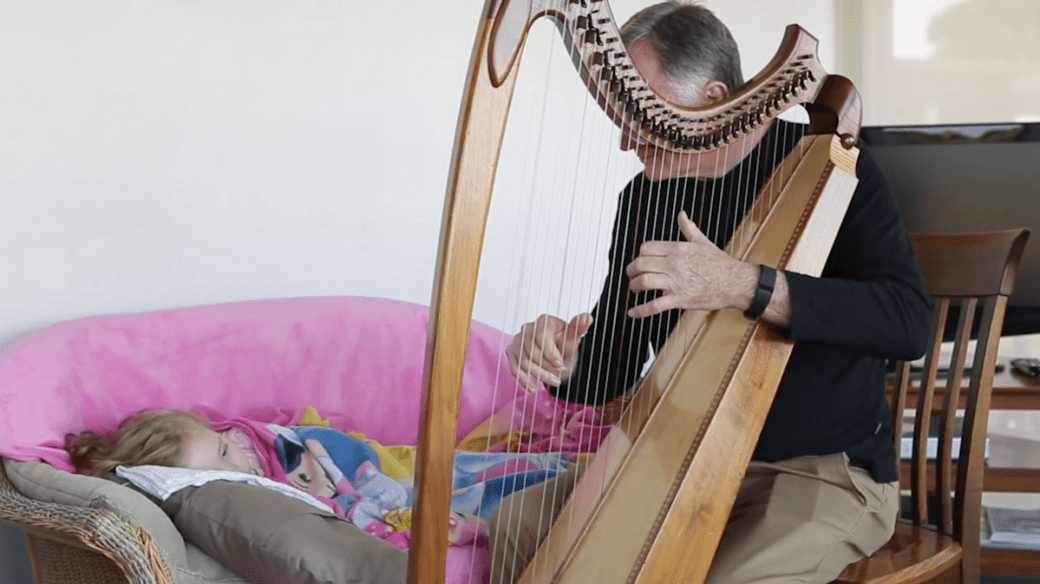
Photo credit: Farshid Akhlaghi, from the film From Music Into Silence.
Reminiscing on the study, Dr Cox spoke about the effect music-thanatology had on one patient in particular who was given the pseudonym Alice, saying: “Alice was a retired musician, and in the beginning when Peter played to her she would be trying to work out what key Peter was playing in, and it was structural things like that which she was focusing on at first because she didn’t want to know about dying. She was frightened. I think the first time we went to the ward, and we asked the nurse if it was alright if we played for Alice the nurse said ‘Play for her? Play the harp for her? I’d rather wrap the bloody thing around her head!’ because Alice was so frightened and demanding.
“However, once she stopped analyzing the music and just started to enjoy it, everything about her changed. She just gradually accepted she was dying, and eventually died really peacefully. It was amazing really.”
Talking about his experience playing for Alice at the end stages, Mr Roberts said:
“She got to the stage where she let herself go into it. She had a concern of letting herself go into it because of the emotions, and she was fearing she would be overwhelmed but, in fact, she found a peacefulness in it. We became very close, we understood each other, we didn’t need to speak to each other, and she had an amazing experience where she said ‘I don’t normally talk like this but it felt like I had light streaming out of my fingers‘.”
Despite its frequent positive effects on patients, music-thanatologists are struggling to support themselves full time.
On this subject, Ms Franz said: “Right now, because of the financial burdens on healthcare systems, hospitals, and hospices it’s harder for music-thanatologists to get a good living wage. We don’t train volunteers. We train professionals who go out to get a full time job.”
Talking about these struggles Dr Cox says: “There are some real structural boundaries for music thanatology. In the public sector, there is such a demand for such a little amount of money that it’s very hard for hospitals to devote something to what they will see as esoteric compared to breathing machines and intensive care.”
Another big problem in the world of Music-thanatology is that the only schools that offer specific Music-thanatology courses are in America, making it extremely hard for aspiring music-thanatologists outside the country to get the training they want.
Talking about the problems her school has faced, Ms Jane Franz said: “We’re a licensed private career school in the state of Oregon, and when we have classes that’s where they are held so no matter where you are that’s where you’ve got to come to.
“At present we are not allowed to take foreign students. The regulations here in the US are just prohibitive when trying to get visas, as you can imagine it’s not a good time for people to be trying to come here. Which is unfortunate: it’s one of our greatest desires to get past that hurdle and be able to take students from all over the world,” Mr Roberts said, “Initially when I came back to Australia after my training, I wanted to start a school in Australia and when I had the non-profit charity I thought, here I go this is my chance but I needed music practitioners from America to teach the students, and it just wasn’t economically viable. It broke my heart that I couldn’t do it.”
Roberts continued: “Nowadays, in the last couple of years I think, the situation in America is that the insurance companies don’t allow aliens as they call them to play within the hospitals, they are not covered by insurance so therefore music-thanatologists outside of America are not allowed to train now it’s really limiting it to America.”
Music-thanatology helps those suffering with their mortality to die in peace. However, more needs to be done to alleviate the financial and travel burdens of the experts in order for this branch of palliative care to grow.