From seven feet of tubing to prisoners drowning beneath a white sheet, law professor Corinna Lain exposes the hidden science, secrecy and human cost of America’s lethal injections.
Lethal injection is America’s most common execution method: a death by drugs presented as controlled, humane and medically managed.
But according to Corinna Lain, a law professor and author of Secrets of the Killing State: The Untold Story of Lethal Injection, the people pushing those drugs are often not doctors.
In every case she has been able to identify, Corinna says the syringes are pushed by non-medical prison guards. They may not be in the execution chamber at all. Instead, they can stand in a small room on the other side of the wall, pushing drugs through seven feet of tubing into the body of a condemned prisoner.
By then, the prisoner has already been strapped to a gurney at the ankles and wrists. In some states, the hands and fingers are taped down too.
Corinna says anaesthesiologists have warned that fingers can be one of the last places where distress is still visible once a paralytic begins to work.
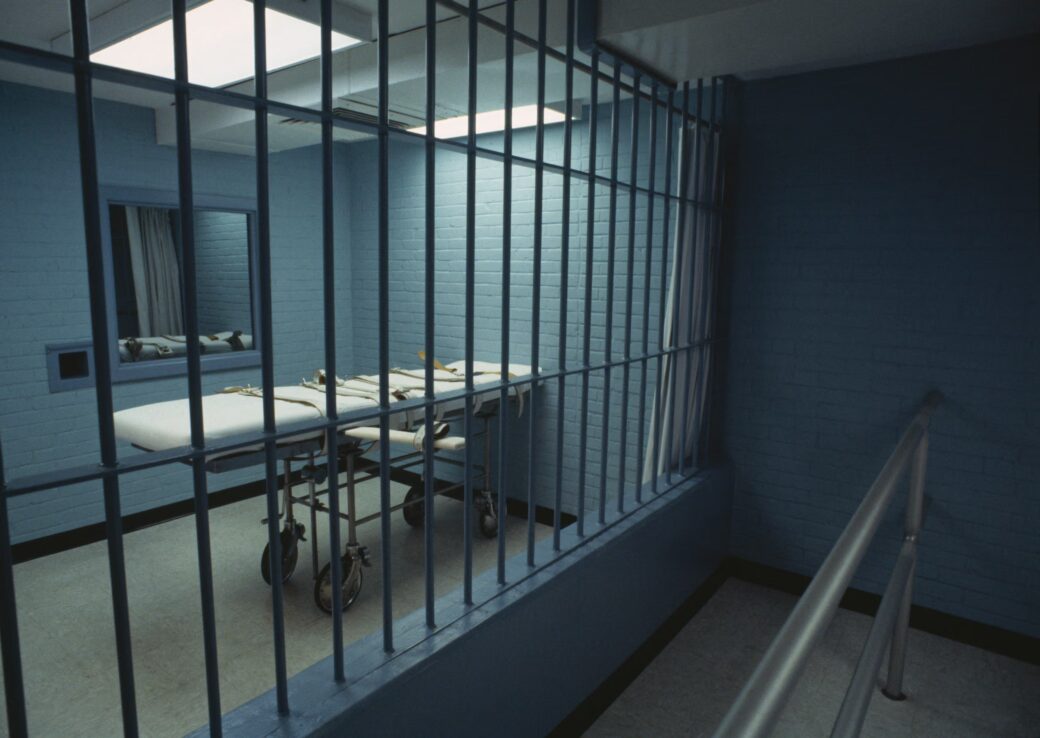
Photo credit: Jerry Cabluck
“If you want to know if someone’s struggling or trying to communicate, look at the fingers, where we have the most motor control.”
Corinna Lain
The prisoner is covered with a white sheet. Someone enters to establish the IV and insert a catheter. Corinna says these people are not usually doctors. They may be phlebotomists, paramedics, or people with similar training.
A warden may be in the room to observe the execution, but Corinna says that does not mean they can recognise a medical problem before it becomes obvious.
“The warden is not a medical person,” she says, “They will only know when something’s going wrong when everybody knows that something is going wrong.”
Some states carry out a consciousness check before the final drugs are given. Corinna says that can offer false reassurance.
“Just because someone is unconscious doesn’t mean they’re anaesthetised,” she says.
At the end, someone checks whether the heart is still beating. A doctor usually enters only after that point, not to treat the prisoner, but to declare them dead.
A method made without science
Lethal injection was not created from an established medical or veterinary protocol.
Corinna says it emerged in 1977, after the US Supreme Court had reinstated the death penalty and after Gary Gilmore’s execution by firing squad in Utah. States that wanted to continue executions were looking for a method that would appear less brutal.
Legislators were not only thinking about how to kill. They were thinking about what the public might see.
“They were actually talking about it in the legislative records, saying, well, we can’t have an electrocution in someone’s living room. You’ve got to do something that looks humane, that looks acceptable.”
Corinna Lain
Oklahoma officials turned to Jay Chapman, the state coroner. Corinna says Chapman later described himself as an expert in dead bodies, but not in how to get them that way.
When Chapman was asked how he came up with the three-drug protocol, his answer undermined the idea that lethal injection began with science.
“He literally said, ‘I didn’t do any research. I just thought about what might be needed,’” Corinna says.
The addition of the third drug was no more carefully explained.
“He literally said, ‘Why not? Why does it matter why I chose it?’”
According to Corinna, Oklahoma adopted the protocol without scientific, medical or veterinary review. There was no expert testimony. There were no committee hearings. Other states then copied it.
What happens inside the body
Execution autopsies have revealed a pattern that, Corinna says, changes how lethal injection should be understood.
Many prisoners executed by lethal injection die with acute pulmonary oedema, where fluid enters the lungs.
“What we know now from execution autopsies is that 84% of these prisoners are dying by acute pulmonary oedema,” she says.
The condition can produce panic, gasping and the sensation of suffocation. In one court hearing, Corinna says medical experts were asked whether it resembled waterboarding. They said yes.
“These people are literally drowning on their own fluids,” she says.
A paralytic can conceal that suffering. Witnesses may see a still body under a white sheet. They may not hear panic. They may not see struggle. The official record may call the execution successful.
Stillness is not proof that the person did not suffer.
The process can also fail at the vein. Lethal injection depends on IV access, but Corinna says death row is an ageing population, often with histories of poor health. Some prisoners have damaged veins from previous drug use. Others have bodies weakened by illness, incarceration or age.
The drugs are not slowly administered through a drip. Corinna describes the process as a bolus overdose, meaning the drugs are pushed in all at once.
The pressure can make the procedure fail before the drugs have done what the state promised.
“The veins collapse,” she say, “The catheters can pop out.”
Those problems can happen even in a healthy person. The people being executed are often not healthy. The people trying to establish and maintain IV access are often not doctors.
The cost of death work
Corinna does not describe every executioner as someone who set out to kill.
Some medical professionals say they were only there to pronounce death. They did not intend to take part in the execution itself. Then they watched less qualified people struggle to find a vein for 45 minutes, two hours or longer.
In Alabama, Corinna says one execution lasted nearly three hours. More than two of those hours were spent trying to establish IV access. The body was later found with multiple puncture wounds.
State killing, in her account, can draw people in gradually, until observation becomes participation.
The non-medical prison guards who carry out executions can also be traumatised by the work. By the time an execution warrant is issued, some have lived alongside the prisoner for 10, 20 or 30 years.
By then, the person being executed is not only the person who entered prison decades earlier.
“We know they’re not the same person they were. We’ve gotten to know them as human beings, and then we have to kill them.”
Corinna Lain
Corinna found accounts of depression, divorce, drug use and alcohol use among executioners. Families were affected too. Some relatives only learned after a death that their father or husband had been part of an execution team.
Other executioners became numb. One line has stayed with Corinna.
“It was really hard at first,” one executioner said, according to Corinna, “But now it ain’t no different than getting a beer out of the fridge.”
For Corinna, both outcomes expose the damage done by asking people to carry out executions.
“We’re either destroying these people, or we’re actually creating the cold-hearted killers that we say we are executing,” she says.
The secrecy around lethal injection
Corinna describes secrecy laws as “the Harry Potter cloak of invisibility over lethal injection practices”.
The laws began by protecting the identities of executioners. Over time, Corinna says, they expanded to cover drug suppliers, protocols, execution team members and information about how states chose their methods.
Her description of what those laws protect is simple.
“They’re protecting everything they can,” she says.
Some laws prevent even courts from accessing key information. That matters because prisoners have a constitutional right not to be tortured to death. If they cannot access information about the drugs, the protocol or the people carrying out the execution, that right becomes almost impossible to enforce.
Secrecy is also built into the room. Some states turn off the sound in the execution chamber after the prisoner’s final statement. Corinna says this began after botched executions where prisoners could be heard gasping.
The solution was not to make the execution less painful. It was to make less of it audible.
“They’re like, oh, we can fix that,” she says, “You just won’t hear it anymore.”
Some states close the blinds when things go visibly wrong. Some prevent reporters from bringing pens or pencils, forcing them to rely on memory rather than notes.
When an execution becomes difficult to witness, the state does not always change the method. Sometimes it changes what witnesses are allowed to see.
The person at the end
The book also changed how Corinna saw the people on death row.
For years, she studied the death penalty while keeping emotional distance from the condemned. Lethal injection forced her to look not only at what they had done, but at who they had become by the time the state killed them.
The result surprised her.
“What I found was so much redemption on death row,” she says.
She does not argue that the original crimes disappear or that harm is undone. Her point is that the death penalty treats one moment as the whole person.
“We tend to freeze these people in a moment in time,” Corinna says, “They change just like we do.”
For Corinna, the morality of lethal injection is not only about the drugs, the secrecy or the people pushing the syringes. It is about whether the state can be trusted to decide that a person’s story is finished.
Corinna lAIN
“The death penalty is putting a period in a sentence when God is still talking.”

About the expert: Corinna Barrett Lain is a leading death penalty scholar, law professor at the University of Richmond, former prosecutor and author of Secrets of the Killing State.
Below, she answers Dead Curious readers’ frequently asked questions on lethal injection, secrecy and the death penalty.
FAQs
More than 200 people have been exonerated from death row.
According to Corinna Lain, 82% of studies have found that race influenced the likelihood of receiving the death penalty.
Old age.
The longest execution in US history lasted nearly three hours. It was the 2022 lethal injection execution of Joe Nathan James in Alabama.
No. There were zero pharmacological studies of lethal injection before it was used to kill prisoners.