
At workshops in Accra, families commission coffins shaped as fish, planes, cars and lions, each one built to carry the body and the story of the person inside.
At Kane Kwei Carpentry Workshop in Labadi, on the edge of Ghana’s capital, death doesn’t come as a plain wooden box.
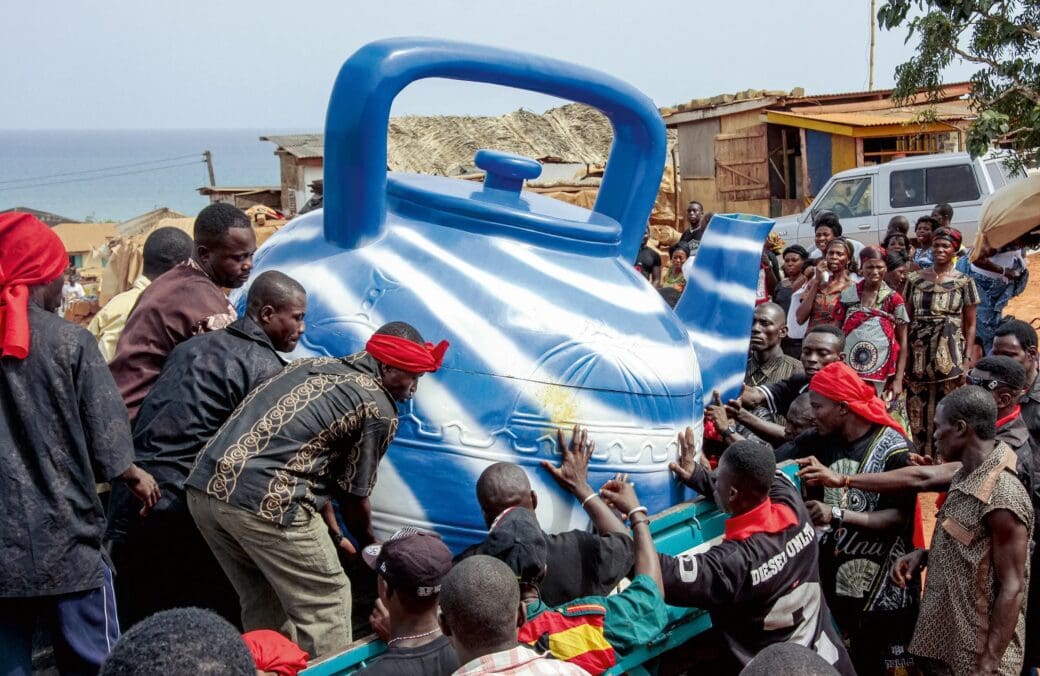
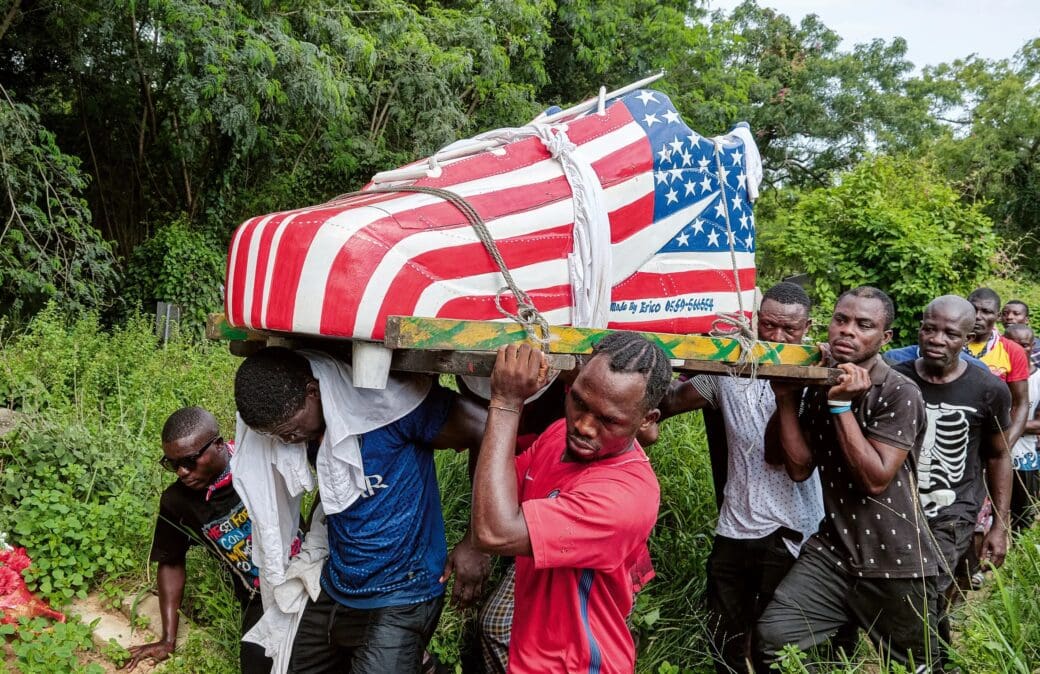
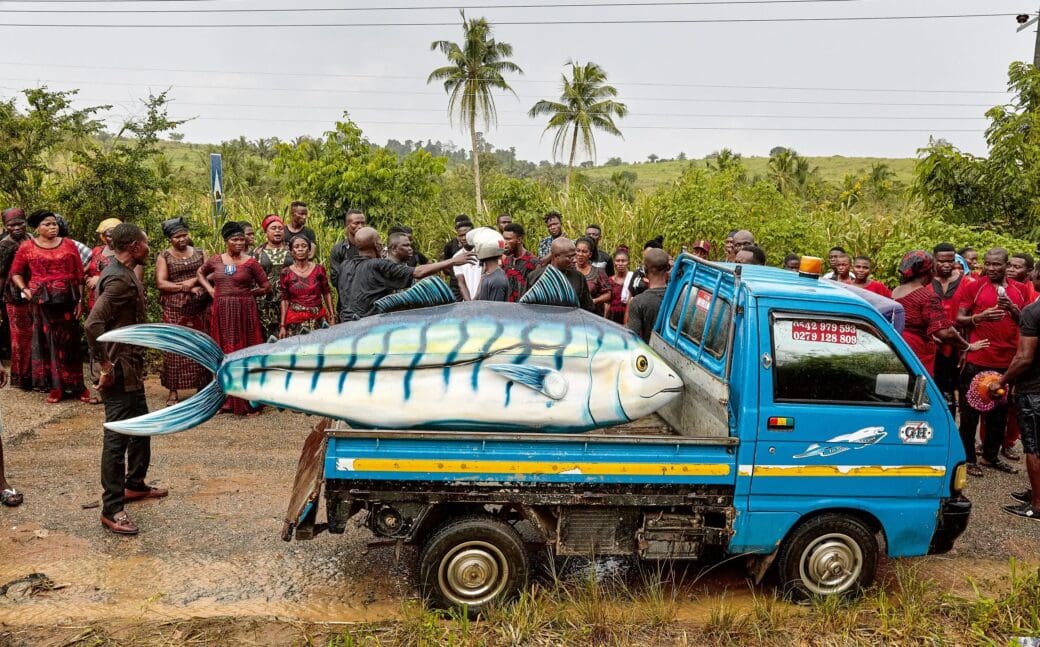
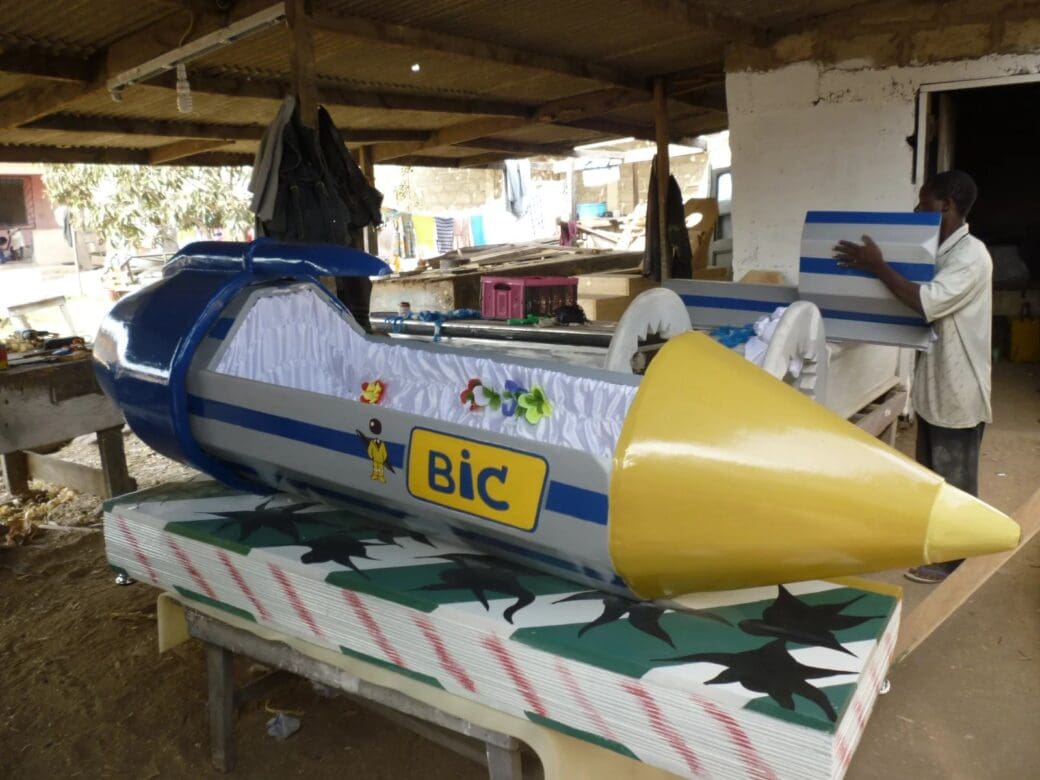
It may arrive as a fish, a plane, a football boot, a sewing machine or a bottle of talcum powder. It may be painted in bright colours, carried through a crowd, sung over, danced with and understood before anyone has to explain it.
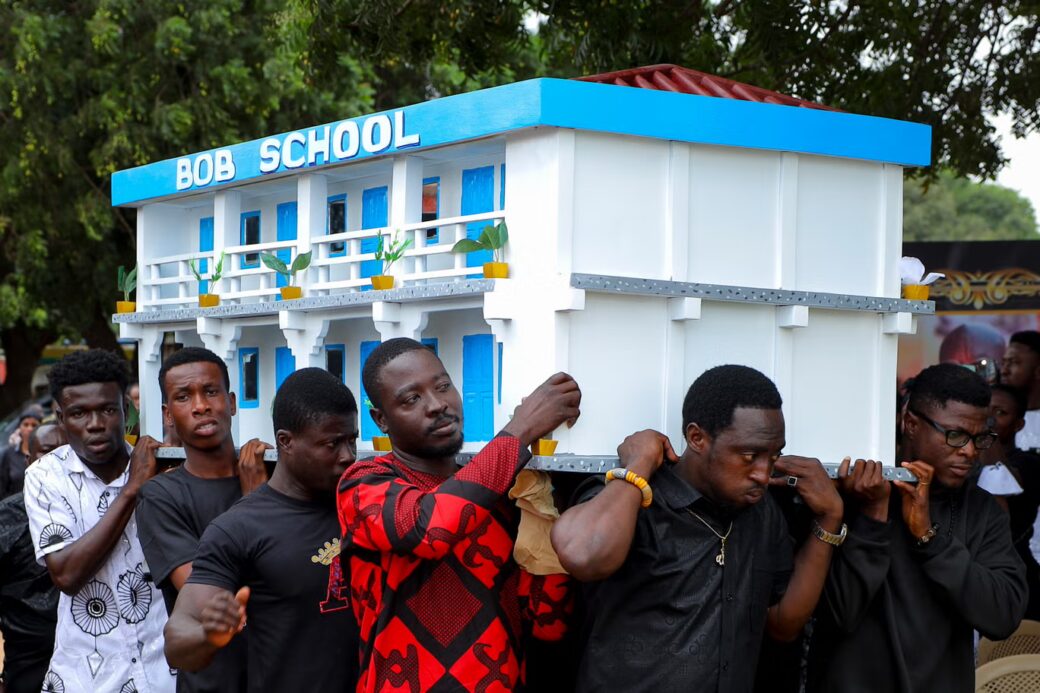
After someone has died, families come to Eric Adjetey Anang with an idea of what should carry them. Sometimes it is obvious: a fish for a fishmonger, a cocoa pod for a farmer, a microphone for a musician. Sometimes the choice reaches further into a person’s hopes. A plane can honour someone who has always dreamed of flying. A sports shoe can speak for a footballer whose ambitions stretched beyond home.
Credit: Regula Tschumi

“Your coffin speaks about you.”
Eric Adjetey Anang
In Ghana, these coffins are known as ‘abebuu adekai’, often translated as “proverb boxes”. They are made to be read as much as seen, carrying clues about a person’s work, status, dreams or place in the community.
The tradition is most closely associated with the Ga people of coastal Ghana, where funerals are often public, symbolic and deeply social. The coffin is not simply part of the burial. It is part of the language of the funeral.
A fish does not only mean fish. It may mean years at sea, early mornings at market, hands smelling of salt, a family fed by one person’s labour. A sewing machine can carry the memory of a tailor whose work passed through half the village. A teapot can point to ritual practice. A plane can turn an unrealised wish into one final journey.
Eric explains the symbolism through what happens when mourners see the coffin.
“If you see a mic, it tells people it’s a musician,” he says. “People start thinking: a musician? What kind of song did he sing when he was alive? It changes the atmosphere.”
Eric belongs to a craft lineage that reaches back to Seth Kane Kwei, a carpenter from the Accra suburb of Teshie who is widely credited with popularising Ghana’s figurative coffins in the 1950s. Kane Kwei then trained Paa Joe, one of Ghana’s best-known fantasy coffin makers. Eric trained under Paa Joe before becoming a master carpenter himself and opening Erico Carpentry Workshop in 2006.
Eric adds: “My grandfather always told me that wherever you find yourself in this world, you should keep knowledge at your fingertips. He said that when he was gone, his knowledge would go with him, and that would be the moment people saw what I had learned. I hope that time is now.”
These coffins can look playful from the outside, but the choices are not random. Some symbols carry authority and cannot be used casually. Lions, eagles and elephants are associated with chiefs, kings and religious leaders. In Labadi, royal families are linked to the rooster. A coffin can honour someone, but it can also overstate them. In a tradition built on recognition, the wrong image would say the wrong thing.
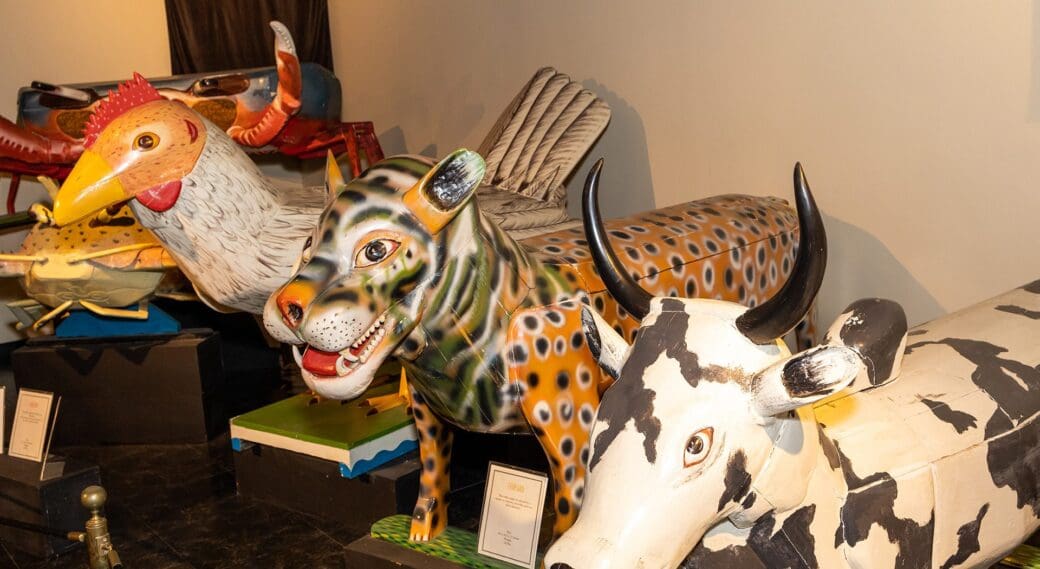
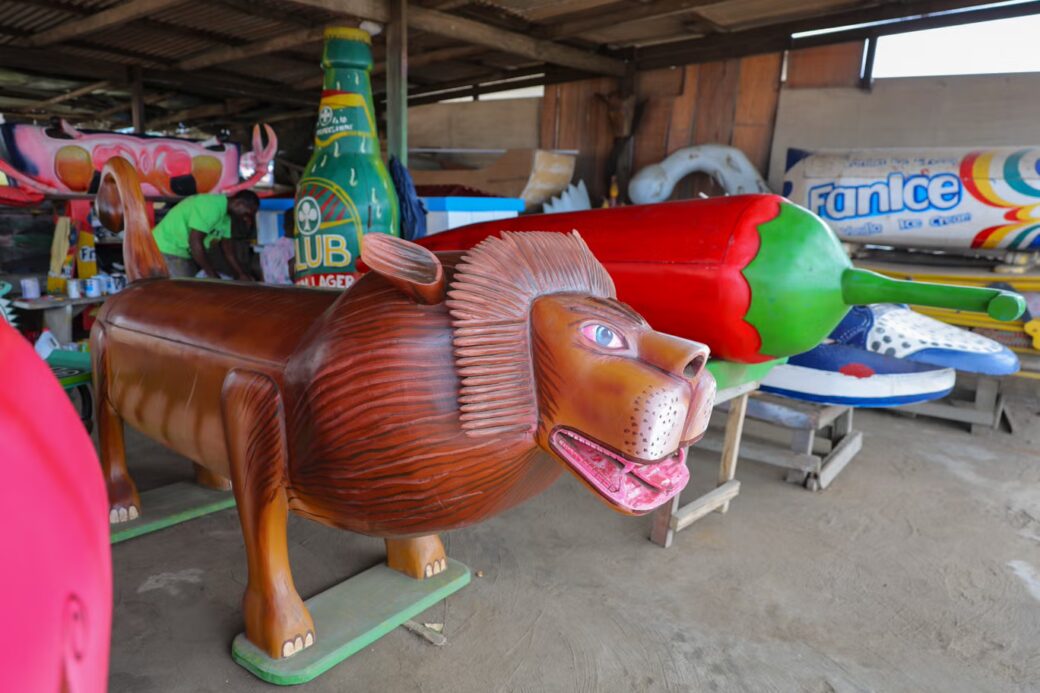
Once the family has chosen the form, the workshop turns memory into labour. Wood is cut, curved, sanded, painted and corrected. The coffin has to look instantly recognisable, but it also has to work as a coffin. It must open, close, hold a body, be carried through the funeral and lowered into the earth.
At the funeral, that recognition changes the mood. Mourners arrive expecting to look at death and find themselves looking first at craft, colour and memory. They talk about the object, and through the object they talk about the person: what they sold, what they made, where they worked, what they wanted, how they were known.
The tradition has now travelled far beyond the funerals that shaped it. Ghana’s fantasy coffins appear in museums, galleries and private collections around the world. Some are still made for burial. Others are made for display and may never hold a body at all.
That shift has brought international attention to the craft, but it has also changed the way the coffins are seen. In Ghana, the object begins with bereavement. Outside Ghana, it can become spectacle: the phone coffin, the beer bottle coffin, the giant trainer, the fish coffin admired for its strangeness before its meaning is understood.
Eric is aware of that tension: “I kind of have to be careful what role I play in the design coffin industry.”
The concern is not that people admire the work. The concern is what happens when a funeral object is separated from the funeral culture that gave it meaning. Once a coffin leaves Ghana for a gallery, collector or tourist photograph, it can be looked at as art, humour, craft or curiosity. What is easier to miss is the family that first needed the object to say goodbye.
Eric’s answer is to keep returning to where the work comes from.
“This is our culture. This is for Ghana.”
Eric Adjetey Anang
Asked what coffin he would choose for himself, Eric does not choose a lion, a car or an aeroplane.
He chooses a wooden hand.
The hand measures, steadies, cuts, sands and paints. It is the part of the body that has spent a lifetime turning other people’s memories into form. After years of shaping final farewells, Eric imagines being remembered through the thing that made them.
In Ghana’s fantasy coffin tradition, the dead are not sent away in silence. They leave inside something chosen, shaped, painted and recognised. Before the grave closes, the coffin gives the family one last chance to show the world who this person was.
About the expert:
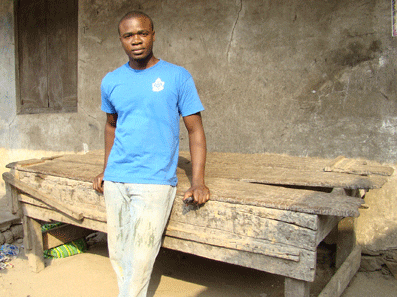
Eric Adjetey Anang grew up inside his family’s fantasy coffin workshop in Teshie, Ghana. At eight, he began learning the tools of the trade; by 20, he had taken over the business, determined not to let his grandfather’s name disappear. Today, he continues the family legacy, sharing Ghana’s coffin-making tradition with the world.