In a world obsessed with finding purpose, one absurdist argues the opposite. Through humour, contradiction, and uncomfortable honesty, this interview explores what it means to live fully in a universe that may have no meaning at all.
The plane drops.
This isn’t generic turbulence – but a sudden, stomach-lurching fall. About a hundred feet, Chris estimates. Long enough for drinks to lift off trays. Long enough for bodies to lift out of seats.
“If you weren’t seatbelted down, you went up,” he says. “It was scary.”
This was a Ryanair flight to Spain, years ago. Chris had flown his whole life – New York to Ireland, back and forth – but this was a first for him. This felt like the moment where you realise you might be about to die.

He turned to his sister-in-law next to him, who had begun to cry. Chris says he was close to crying too. Instead, he cautiously leaned his head, peered down the aisle and looked at the flight attendant.
“She was sitting down. Calm. Fine,” he says. “And I just thought — if she’s not panicking, I’m not panicking.”
He didn’t need an explanation. He didn’t need certainty. He just needed to know that someone, somewhere, appeared to be in control.
“So I started breathing. Praying a little bit too.”
The plane didn’t crash. Everyone lived. Crisis averted. But the moment lingered for Chris – not as trauma, but as a kind of philosophical pressure point. Because when death feels close, logic collapses. Belief kicks in. Control becomes precious. And absurdity becomes unavoidable.
Chris Dwyer is a clinical psychologist working at Shannon University, in Ireland. But philosophically, he’s an absurdist. Let’s begin by getting into what that actually means.
What is absurdism?
To begin to explain what absurdism is, it’s important to understand what nihilism is first.
Nothing has inherent meaning, there’s no grand cosmic purpose, and the universe isn’t keeping score. Your job, your morals, your suffering, your dreams — none of it matters in any ultimate sense.
Nihilism gained traction in the mid to late 19th century, after industrialisation and rapid scientific progress led to people losing faith in traditional belief systems. Freidrich Nietzsche, arguably the founding father of nihilism, diagnosed this point in time as the becoming of nihilism, warning that when faith collapses, people risk sliding into nihilism — the sense that nothing matters because nothing is grounded anymore. An existential wave of vertigo had begun to dizzy the thinkers of the world.
Following two world wars, nihilism reared its head even more viciously in the 20th century. Its spread can be explained by a multitude of things: millions were killed for unclear or hollow reasons, faith had been shattered and trauma was gained on an unprecedented scale.
It makes sense why the concept of God and moral order would feel obscene at this point in time. Nihilism was rife not just as a philosophy, but began to appear in art and literature too. Pollock’s chaotic canvases, the tormented figures of Francis Bacon, Plath’s The Bell Jar.
Absurdism is best understood as a response to nihilism. Nihilism says nothing matters. Absurdism agrees — and then refuses to stop living.
Albert Camus, absurdism’s most famous voice, frames the problem brutally: Should I choose suicide or a cup of coffee?
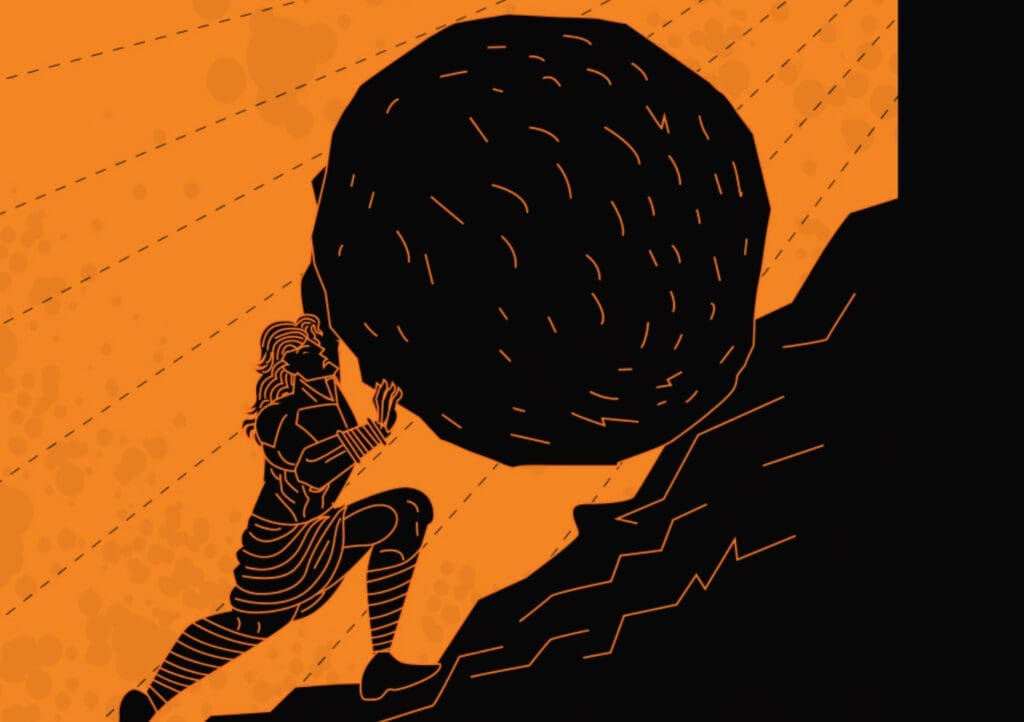
Camus’s answer is the foundation of absurdism: You must imagine Sisyphus happy.
Sisyphus — condemned to push a boulder up a hill for eternity, only to watch it roll back down — is the perfect metaphor for life. Repetitive. Exhausting. Meaningless on paper.
“And yet,” Chris says, “Camus calls this rebelling against despair.”
Not optimism. Not hope. Not pretending things will be okay.
Just refusal.
“If you can’t laugh,” he adds, “you’re going to be crying. We have to take these horrible situations that occur to us and progress regardless.”
In short, absurdism doesn’t deny suffering. It just simply insists we live anyway.
Lights out
Chris doesn’t believe in an afterlife.
“I believe that when the brain dies,” he says, “everything that you are dies with it. Our memories, our experiences — that’s us.”
He pauses, and equips a sentimental, somewhat melancholy tone.
“I would like there to be an afterlife. I think that would be lovely,” he admits. “But do I believe that? No. and so what can I do about that?”
Still, he doesn’t judge belief. He respects it. Applauds it, even.
“Anything you can use to make you feel more comfortable in your existence — go for it.” For him, comfort comes from elsewhere.
“I have a wife and kids. I love them dearly,” he says. “I have maybe seventy years in total. Maybe less. Maybe more. Maybe tomorrow ends everything. Maybe I’ll get hit by a bus,” he shrugs. “My point is — enjoy every second of existence now, regardless of how absurd it is.”
“I find that much more comforting than the idea of trying to live according to some prescribed way in the hopes that we’ve done enough for an afterlife. That’s not to say that we should all become like The Marquis de Sade or something, and just live in debauchery.” I laugh as he references the French provocateur known for his writing focused on sex, violence, atheism, and philosophy – so extreme that his name gave us the word “sadism.”
“No, I mean we can have a moral compass and still do what we want and do what makes us happy, and be good people. So be happy with what you have now because you don’t know what’s coming at the end.”
An absurdist’s advice on your last 20 seconds
Chris loops back to that terrifying Ryanair flight to answer this question.
“I think a true absurdist, if we were to take a 1960s French film by rights, would just get naked on the plane. And then, empty the drinks cart in their final seconds, and that would make a great end for a film, purely something out of Monty Python, the Holy Grail. That’s a really absurd way of looking.
We are all going to die. Accept that. But let’s take the time we have now and live that to the fullest. And so what’s absurd? Yeah. I guess the kind of debauchery that I just explained would be absurd in one way. But what could we do meaningfully in our last 20 seconds? look our loved ones in the eye and tell them we love them.
Chris was in New York on 9/11. He remembers students queuing for landlines, crying, trying to reach parents who might already be dead.
“I was a junior in high school when we found out. We heard a shout over the loudspeaker. The twin towers have been hit. The speaker then told us if you have any loved ones working in the city, come downstairs now and make a phone call. Mobile phones were new at the time. Teenagers didn’t typically have them and if they did they weren’t allowed in school. Some kids were sneaking into the bathroom to call if they did have a phone, and t others were waiting on landlines.
He often thinks about final moments. People on planes making phone calls. Decisions made under the weight of certainty.
“What do you do with that time?” he asks. “That’s the scary thing,” Chris says. “There is no definitive meaning. You have to create your own.”
A Bullet Would Be Ideal
“I’d love to die in my sleep. I hope I die in my sleep. I hope I never have to process my death – that’s the scary thing. If you could just get shot in the back of the head or something like that, I know that sounds terrible, but you don’t know what’s coming.
What do you do with those last few moments? That’s heavy, and I don’t think anyone really knows until they’re put in that position. But, in a very existential way, you’re dying and I’m dying. We just don’t know when.”
Chris makes a great point here. There’s always a bullet flying towards the back of your skull. Speed unknown, but direction certain nonetheless. That’s the reality to absurdists.
“So, what are you going to do with that time left? You could be really grumpy and depressed and say, “What’s the point? What do I care?” A classic nihilistic outlook.
“Or you can try and do something meaningful with that. What’s meaningful is different to every person. And again, I wouldn’t judge your meaningfulness as I would expect you wouldn’t judge mine.
“We can’t agree on a meaningfulness. Absurdism explains there’s no shared meaning.. You have to create your own meaning.”
“The End”
We don’t agree on meaning. We don’t agree on what happens when we die. We don’t even agree on whether any of this matters at all. But Chris doesn’t seem bothered by that. The plane landed. The boulder rolled back down the hill. If absurdism doesn’t offer answers — it offers permission. Permission to stop demanding sense from the universe, to accept that the plane might crash, and to live anyway. Have the coffee. Breathe. If the flight attendant isn’t panicking, maybe you don’t have to either.