
Executions were a grisly spectacle, but people once flocked to see them up close and in person. That begs the question – what drew people in, and why were they stopped?
Imagine a family day out in the 1600s: you and the rest of the village gather on a nearby hillside where a wooden platform has been set up. The air is brimming with excitement.
A man appears, and the children point and gasp as the prisoner is hauled up to the gallows to face their fate. This macabre image might be far removed from modern media like video games and television, but back then, it was the prime attraction for ordinary folks.
Death has played an important part in entertainment for millennia.
In Ancient Rome, crowds watching gladiator battles at the Colosseum could see condemned prisoners get thrown into a pit with lions and other wild animals. According to historian Dr Patrick Low, public executions were especially prominent in Britain between the seventeenth century and the mid-nineteenth century.
“They contained many ingredients of popular entertainment in earlier centuries: drama, suspense, occasional celebrity, crowd excitement and spectacle.
“For many ordinary people, organised leisure opportunities were limited. A hanging was a rare public event that everyone talked about.”
The crowd itself also added to the attraction.
“Thousands gathering together generated noise, anticipation and emotion. Street sellers, drinking and conversation often made the day feel closer to a carnival than a solemn legal proceeding.
“Morbid curiosity also played a major role.
“Death was more familiar in everyday life than it is now, but witnessing a state execution remained relatively extraordinary.”
In an article for Medievalists.net, Danièle Cybulskie says that punishment varied depending on the severity of the crime.
Hanging was the punishment for thieves, whilst breaking with the wheel was the harshest punishment reserved for crimes like murder.
Arsonists, heretics, and witches were burned, whilst women charged with offences against religions or morality such as adultery were drowned.
Decapitation was also used for a wide range of offences, including manslaughter, robbery or major fraud.
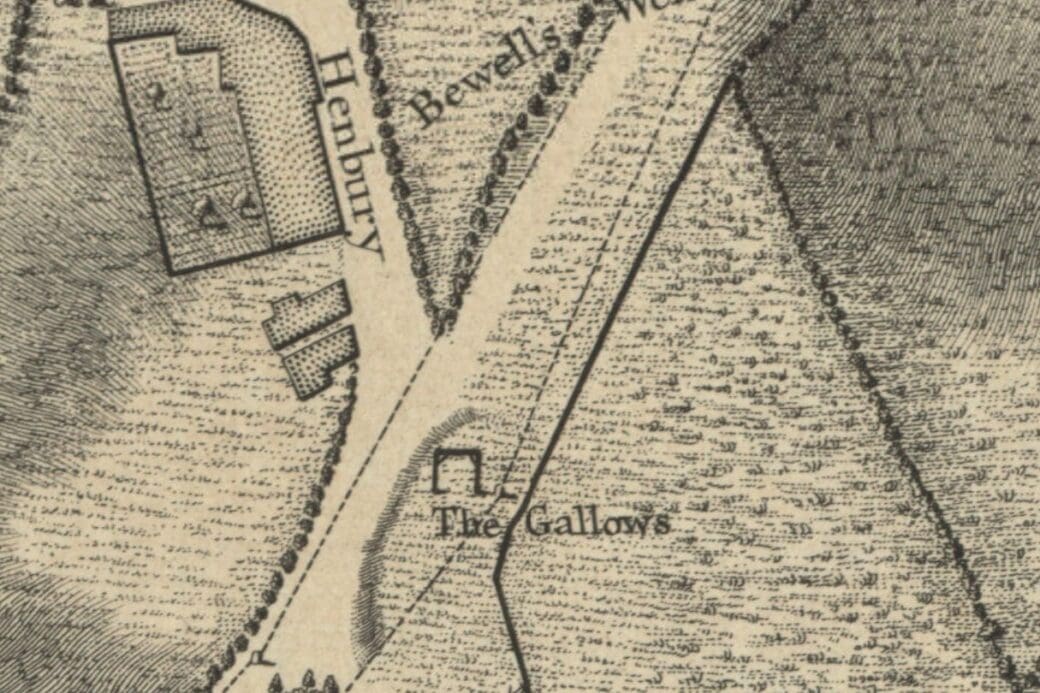
(Credit: John Rocque via Wikimedia Commons)
But executions weren’t held in public solely for entertainment purposes. Dr Low says governments at the time believed justice had to be visible if it was to command respect.
“Authorities could demonstrate the power of the law, warn others against crime, and show that court sentences were being enforced.
“In an age before mass media and established police forces, the gallows acted as a dramatic public message.
“Executions also had a moral and religious purpose – the condemned person was often expected to confess wrongdoing, express repentance and prepare for death in front of the crowd.”
It wasn’t just restricted to common criminals, either. Charles I was publicly beheaded in London after his defeat in the English Civil War.
During the French Revolution, the guillotine was famously deployed to execute Louis XVI and Marie Antoinette in front of a roaring Parisian crowd. But the public tide eventually turned towards reform.
Dr Low says that public executions were eventually stopped because increasing numbers of people believed they were failing their intended purpose.
“Instead of deterring crime, many hangings had become chaotic spectacles.
“Critics also argued that repeated exposure to public death could brutalise society rather than morally improve it.”
The move away from large open-air execution sites happened unevenly across the country, but the Capital Punishment Amendment Act of 1868 ended public executions in Britain. Instead, they were required to take place within prison walls.
Eventually, the death penalty was abolished altogether in 1969.
However, some countries continue to hold public executions – namely Iran and North Korea – using them entirely as instruments of fear.
Hundreds of years later, mortality continues to play a major role in modern-day entertainment. It can be seen in all sorts of media, from slasher films to military-style shooters to true crime documentaries.
We may no longer seek to witness it in person, but our morbid curiosity towards death definitely hasn’t wavered.