Skeletons were once a medieval warning to fear incoming death. So how did they become cartoons, memes and party decorations? This feature explores how bones were stripped of their menace and what it says about today’s attitude to mortality, through conversations with artists and art historians.
Skeletons, once a stark religious warning of mortality, have become strangely lovable; an image reinvented from prophetic plague paintings to modern meme material.
These days our deadly depictions serve us comically, as images we can play with and laugh at online. It’s a far cry from church carvings and ‘danse macabre’ murals that served to confront people with the inevitability of their end.
The shift didn’t happen overnight. Nor, according to art historian Dr Sophie Oosterwijk, were they purely painted to provoke dread to begin with.
“In medieval danse macabre imagery, a moral ‘memento mori’ (be prepared for death) warning was evidently intended as the overall message to the viewer. However, medieval people enjoyed a combination of farce and horror,” says Dr Oosterwijk.
“There is obviously satire in the way skeletons mock figures of power, from popes to kings.”
Medieval danse macabre – literally meaning “dance of death” – appeared in Europe after the Black Death. In prints and murals, skeletons would drag people of all levels of society into a morbid dance towards their graves. A blunt message was revered: “remember that you must die.” Often skeletons grinned. Some played instruments. Others tugged at richly dressed churchmen or leered at noblewomen with theatrical antics.
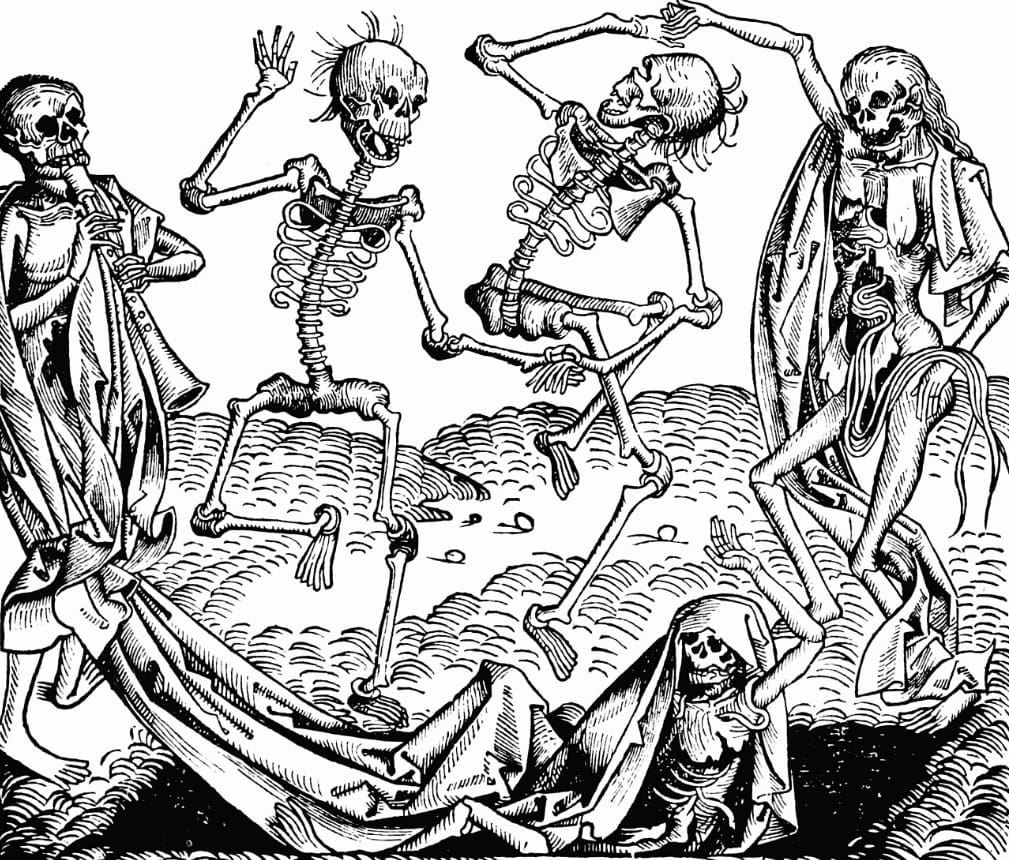
To a medieval crowd, horror and humour were far from opposites.
Dr Oosterwijk points to medieval block books (15th century comic books carved into wood) in which grotesque plots are overlooked by today’s audiences.
“There are many more such examples, such as the ‘phallic worms’ in some depictions,” says Dr Oosterwijk.
“The corpses are truly funny.”
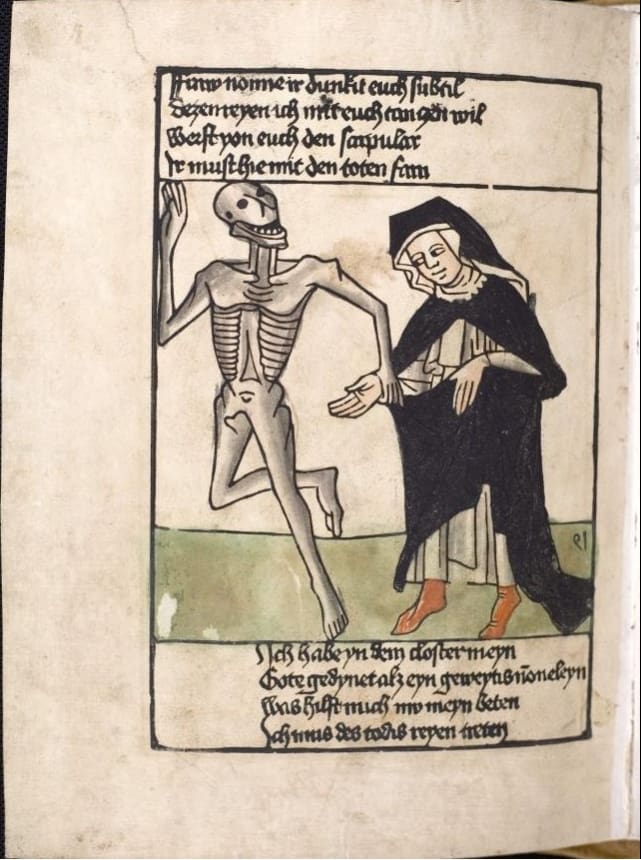
That tension, a product of revulsion and comedy, is precisely what preserves skeletal imagery. A skeleton is chilling because it is universal. Everyone can recognise themself in it. But it is also absurd. A grin forever frozen, limbs reduced to sticks and hinges; an awkwardly theatrical transformation of the body.
“The rictus of the skull suggests that Death is mocking us,” Dr Oosterwijk says.
This mocking quality became progressively more important as skeletal imagery emerged from the papers of religious texts into popular visual culture. Art historian and author Dr Paul Koudounaris claims that this change intensified during the nineteenth century, as printmaking and commercial expansion broadened who art was actually for.
“At one point in time artwork was for the high and mighty,” says Dr Koudounaris.
“It was expensive commissioned stuff and therefore tended to be more serious. When printmaking comes along it changes the dynamic – there can now be art for the lower classes as well.”
This made deceased drawings more marketable and increasingly playful, with skeletons emerging in comics, satirical cartoons and cheap prints. Dr Koudounaris believes that medieval attitudes towards mortality are misunderstood by today’s audiences, as we see the past as grave and emotionally distant.
“We have this tendency to look at something from a Medieval cloister and think, ‘Wow, that was a very serious world back then,’ without understanding that visual culture was a very different situation,” he says.
In actuality, medieval society was accustomed to public death in ways contemporary audiences are not. Disease, executions and infant mortality were a part of everyday life. So what is stranger? The fact that medieval audiences laughed at bones on occasion, or that contemporary Western culture can hide death almost entirely, while turning skeletons into mascots at the same time?
This contradiction we’re exploring demonstrates why today’s skeletal imagery feels so sanitised. Cartoon skeletons circulated in the media today rarely fester, or carry a rotting stench. You don’t see the flesh, decay or suffering. Bones are clean. Friendly. Familiar. Safe.
“Beauty is but skin-deep, and there is a skeleton inside each of us,” says Dr Oosterwijk.
But modern media will strip it of everything uncomfortable surrounding that truth.
Gothic sculptor Kris Kuksi claims familiarity has fundamentally shifted the effect of skeletons in art today.
“It’s become so mainstream that I think its meaning is very drained now,” he says.
“There’s so much acceptance of skeletal imagery being playful. Even toys for girls these days – the whole ‘Monster High’ doll line uses skeletal imagery.”
In other words, bones now reach people comfortably through toys, fashion, music and internet culture.
“The playful use of cartoons by especially the young is very much denial,” she says.
“They ‘play’ with the idea of death as something remote and funny.”
Kuksi notes similar desensitisation in modern visual media. He says: “Nowadays it gets harder and harder to make skeletons scary.
“Compared to the satanic panic of the 1980s, people are pretty desensitised now.”
In various subcultures, such as alternative music spaces, skeletal imagery has become aesthetic shorthand as opposed to a way to instil fear.
Yet, Oosterwijk would still rather make a punchline out of bones, than observe them as a tool for tone.
“I do think I prefer humour to the romanticising and hiding away of death as the Victorians did.”
The Victorians would veil death beneath idealisation and sentimentality. Sculptures on tombs painted peaceful sleepers rather than decaying corpses. This eased the thought of death, allowing people to treat it in a more private, and aesthetically controlled way.
But today’s skeletal wit challenges this repression. We don’t pretend death is non-existent. We transform it into something visible and socially shareable.
Dr Koudounaris believes that comedy can open doors that fear closes: doors being conversations on the morbid topic. Researching ossuaries (chapels featuring human bone decoration), he observed worries about visitors taking selfies next to skeletal remains. But he wholly disagreed with the criticism.
“For many people, that is their way of functioning within society. Bring the death space, and the topic itself, into their world and normalise it as something to be interacted with,” he says.
Now this doesn’t mean behind every drop-jawed skeleton meme there is deep philosophical substance. Bones can make people giggle. So perhaps simplicity is the key. Skeletal imagery is successful because it peels back death to its most basic visual form. No language, religion or nationality are obligated to understand it. Skeletons communicate death on a global scale.
Still, as opposed to realistic skeletal illustrations, they remain abstract enough to play around with. Skeletons exist in an unusual aether between person and object, doom and cartoon. We can feel entertained without fully tackling their morbid meaning.
Danse macabre grasped this contradiction centuries ago. Those old paintings were performances as much as they were warnings. Skeletons danced through art because the concept of life’s end was theoretical. Horrifying, granted, but also disturbed enough to mock the living.
We, today, did not make skeletons humorous (excuse the pun), but simply stripped away some of the dread and left the grin behind.