Britain still has no human taphonomy facility: a secure research site where donated bodies can be studied after death to help forensic scientists understand decomposition.
The phrase most people know is “body farm”. It belongs more naturally to crime fiction than to the careful, consent-led research Professor Anna Williams is describing. A human taphonomy facility is not a spectacle. It is a place built around one difficult truth: if forensic scientists are asked to read the evidence left by human death, they need to understand what actually happens to human bodies.
“If you went to the doctor and you were going to have surgery, and you asked how many times the doctor had performed that surgery on humans before, and they said, ‘Oh, I’ve never done it on humans, but I’ve done it on pigs’, that would undermine their expertise and authority,” Williams says. “You’d think, perhaps I don’t want them doing the surgery on me.
“And that’s the same problem we have with forensic science. The analogues we’re forced to use are not very good. They’re not very similar to humans. And if you’re going to do rigorous, scientifically robust research for human forensic science, you need to do it on human samples.”
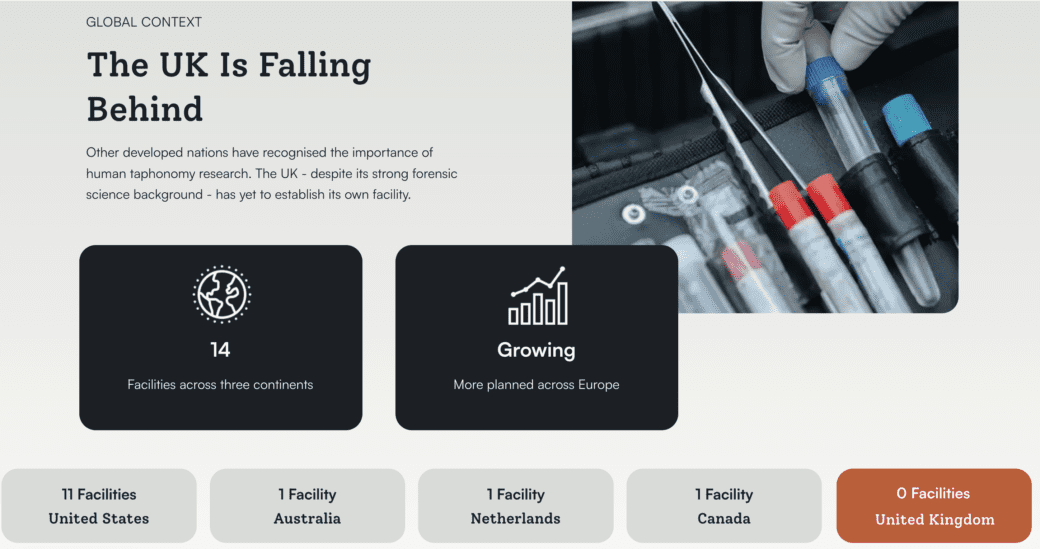
Human taphonomy facilities now exist in several countries, including the United States, Australia, the Netherlands and Canada. Britain is not among them.
What the body can tell us
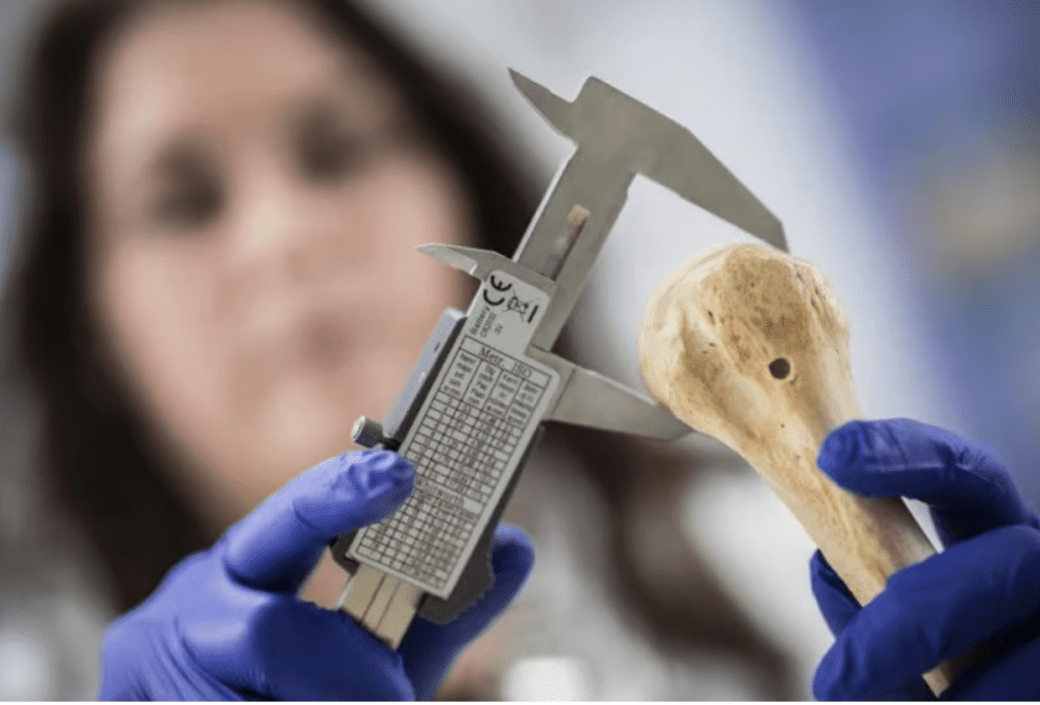
Taphonomy is the study of what happens to the body after death. It looks at decomposition, burial, insects, clothing, weather, water, soil, scavengers and the slow changes that turn a person into remains. In forensic science, those changes can help investigators estimate time since death, search for concealed bodies, understand how evidence degrades and train the people who may one day be called to a crime scene. Human taphonomy facilities are outdoor laboratories where donated human cadavers can be observed for scientific research.
In Britain, much of that work has had to rely on approximation. Researchers use animals, usually pigs. They are practical, available and biologically useful up to a point. But they are not people.
A pig does not smoke for 40 years. It does not undergo chemotherapy, take long-term medication, wear clothes, use drugs, carry tattoos, live with implants, develop the same human illnesses or die with the same complicated medical and social history as the people whose bodies forensic experts may be asked to examine.
“There no substitute for humans in understanding human decomposition,” Williams says.
The question is not whether animal research has value. It does. The question is what happens when a substitute becomes the foundation of an entire national knowledge base.
A UK facility could help answer questions that remain largely unresolved. How does cancer affect decomposition? Does smoking alter the process? What happens when certain drugs or medical treatments are present in the body? How long do fingerprints survive after death? How does DNA degrade in British soil, water or weather? How do decomposition gases move through the ground? Can a perpetrator’s DNA still be recovered from decomposing remains? What role do fungi, microbes, insects and plants play in locating the dead?
“There hasn’t been research on how cancer affects decomposition rate, how smoking affects it, how certain drugs affect it, certain treatments, how diet affects decomposition,” Williams says. “All these things that we can’t replicate with animals.”
A body in Texas is not a body in Lancashire
Decomposition is not universal. It belongs to the place where it happens.
Williams visited a taphonomy facility in Texas last year. By mid-morning, she says, the temperature was already 39C.
“The bodies that are out on the surface are shrivelled and desiccated completely in only a few days,” she says. “Completely different to how they would decompose in cold, rainy Britain with our soils and rainfall.”
Climate is only the beginning. Soil, rain, insects, water, vegetation, clothing, burial depth and animal activity all alter what happens after death. Research from the US can be valuable, but it cannot simply be imported wholesale into British investigations.
“There’s a lot of research that’s come out of the States about how vultures interact with human remains, or coyotes, and there’s great research on that, but we can’t use it because we don’t have the vultures,” Williams says. “We are more interested in how badgers, or squirrels, or foxes might interact with human remains.”
A body in Tennessee is not a body in Lancashire. A shallow grave in Arizona is not a shallow grave in Cumbria. A corpse exposed to Texas heat will not behave like one lying in British clay, rain, woodland or peat.
Written evidence submitted to Parliament by Williams and Professor John Cassella made the same point: the UK lacks the infrastructure to study human cadaver decomposition in its own environments, including surface deposition, burial, water, scavenging, soil and vegetation.
For Williams, this is the heart of the argument. If British courts, police forces and forensic scientists rely on decomposition evidence, then Britain needs decomposition research grounded in British conditions.
Training for death before the scene
The absence of a UK facility is not only a research problem. It is a training problem.
Search dogs in Britain are often trained using animal remains or material associated with decomposition. In real cases, however, they are expected to find human remains and ignore animal ones.
“We need to train dogs that are specially trained to find human remains on human remains,” Williams says. “At the moment, they are trained mostly on animal remains or materials associated with decomposition. And yet, in the field, they’re expected to ignore animal remains and find human ones.”
For human beings, the first encounter with a decomposing body can be even more difficult. Many forensic science students, police officers and military personnel may not experience that reality until they are already working.
“There’s something very confronting about seeing dead humans. What if the body looks like somebody you know? Or what if it’s got a tattoo? Any tiny little thing could be a trigger.”
Professor Anna Williams
The language of forensic science can sound clean: remains, evidence, samples, recovery. The reality is much less tidy. A body has weight, smell, texture, recognisable traces of personhood. It can unsettle even those who have chosen to work with death.
“That’s why it’s really important for forensic science students to experience postmortems, to know how they feel when they see a dead body, and to do that in a safe environment, not for the first time when they’re on the job.”
A human taphonomy facility would not remove the emotional difficulty of death. It would make preparation possible.
The legal gap
If the scientific case seems clear, the obvious question is why Britain still has no such site.
Part of the answer lies in regulation.
“There’s a legal grey area,” Williams says. “If we had a human taphonomy facility in the UK, we’d want it to be regulated by the Human Tissue Authority. But when the Human Tissue Authority were writing their scheduled purposes, they didn’t include forensic research.”
The Human Tissue Act 2004 regulates the removal, storage, use and disposal of human tissue in England, Wales and Northern Ireland. Consent is central to the legislation, and the Act sets out specific “scheduled purposes” for which human tissue may be used. The difficulty is that forensic taphonomy does not fit neatly into the existing framework.
“If you want to do forensic research using human tissue, there isn’t a licence you can apply for,” Williams says. “That’s one of the reasons we have this campaign, to lobby the government and the Human Tissue Authority to add forensic purposes.”
Technically, someone might try to proceed outside that structure. Williams thinks that would be a mistake.
“If you’re dealing with human tissue, you ought to be regulated.”
There is another obstacle too: fear. Britain’s history of organ retention scandals has made institutions cautious around anything involving human remains. For universities, funders and public bodies, the scientific case is not the only calculation. There is reputation, press reaction, public unease and the anxiety of being first.
“I think there’s a fear of public outrage. That history makes institutions quite risk averse, and nobody wants to put their head above the parapet.”
Professor Anna Williams
The problem with “body farms”
Language has not helped.
“Body farm” is memorable, but it drags the research towards horror before it has had a chance to explain itself. It suggests something crude, theatrical, almost agricultural. Williams understands why the phrase survives. She also knows what it distorts.
“It’s a double-edged sword,” she says. “It’s not appropriate for what happens at a human taphonomy facility. But it’s catchy, and people remember it.”
The misunderstanding is immediate.
“People think there’s something about growing humans, or that they’re all lined up in greenhouses. It’s not like that.”
The model Williams imagines for Britain is far more cautious. She points to the forensic cemetery in Amsterdam, where bodies are buried underground rather than laid out in the open.
“If you didn’t know there were bodies there, you wouldn’t guess,” she says.
A UK facility, she suggests, might begin gradually. It could start with smaller tissue donations before moving to full cadavers. It could include research areas, teaching spaces and a place for families. In her ideal version, it would not be hidden away as though something shameful were happening behind a fence.
“In my wildest dreams, I could envisage a facility with memorial gardens, visitor centres, teaching spaces. The donors’ families would be able to visit. It needs to have a welcoming community aspect.”
Professor Anna Williams
Death as television imagines it
Much of what the public thinks it knows about forensic science comes from television. Williams has advised on Silent Witness and the American series Bones, both of which have shaped the image of the forensic expert as someone who moves elegantly from body to answer.
On Silent Witness, she once suggested that the characters should wear hairnets for accuracy.
She says: “My suggestions were dismissed…the actors need to have their nice hair”
The detail is funny because it is small. It is also revealing. Television needs forensic science to be legible, dramatic and attractive. Real forensic work is slower, more fragmented and less flattering to the camera.
“I appreciate how these shows make forensic science interesting,” Williams says. “But in real life, it’s not as glamorous.”
Nor is it usually as narratively complete. On screen, the scientist follows the case from discovery to conviction. In practice, the work is often partial. An expert is called in, asked to examine one element, then left outside the rest of the story.
“You do your bit when you’re called in, and you’re not usually told about the outcome,” Williams says. “Sometimes I’ve had to search online to find out if there’s been a conviction.”
That gap between fiction and reality matters. Crime dramas make decomposition look knowable. They turn death into a sequence of clues. But real bodies do not always offer clean answers. They are altered by weather, soil, animals, insects, water and time. Without research, uncertainty remains.
A public more ready than institutions think
Williams does not believe the public is necessarily the obstacle.
“Since I first started asking these questions 15 years ago, there’s definitely been a change,” she says. “I am inundated with people who want to donate their bodies to forensic research. They want to contribute to the pursuit of justice.”
Many are surprised to learn that Britain does not already have a facility.
“It’s an obvious thing that we should have. People are surprised to hear that we don’t.”
The unease, she suggests, may sit less with the public than with institutions imagining public outrage in advance. Death remains difficult to talk about, but not impossible. The rise of body donation, death cafes, natural burial, end-of-life planning and death-positive conversations has begun to soften some of the old silence.
Still, Williams thinks Britain has a habit of looking away.
“We don’t talk about it,” she says. “People spend so much time planning weddings. Why don’t they plan their funerals?”
For someone who studies decomposition, death has become less alien, not more.
“It’s the circle of life,” she says. “It shouldn’t be something that’s thought of as disgusting or scary. It is just what naturally happens.”
What the absence says
For now, the barriers remain: regulation, funding, land, institutional caution and a public language still too easily pulled towards horror. No university, government body or research institution has yet built the facility Williams has spent 15 years arguing for.
But the absence is becoming harder to defend.
Britain trains forensic scientists, relies on expert evidence in court, searches for missing people, investigates suspicious deaths and consumes forensic drama as entertainment. Yet it has not built the infrastructure that would allow researchers to study human decomposition in British conditions, using human donors, with the rigour the science demands.
The dead, Williams argues, still have work to do. They could help find the missing. They could train the dogs. They could prepare the students. They could make court evidence stronger. They could answer questions that pigs, however useful, cannot answer on their behalf.
Find out more about the campaign, and express your opinion here.
Meet the expert: Professor Anna Williams
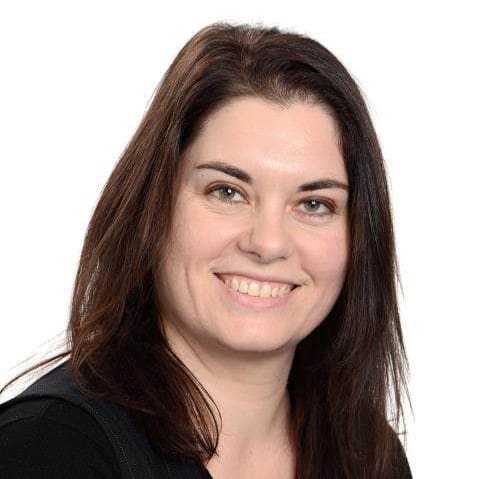
Anna is Professor of Forensic Science. She is a forensic anthropologist with considerable casework experience with police and forensic science providers, and a research interest in forensic taphonomy and decomposition. She supervises MSc and PhD students.