Mourning takes place differently all over the world, and there is no one ‘mainstream’ way to conduct funerals or death practices. Here are twelve global death traditions that have stood the test of time.
- Día de los Muertos – Mexico
This festival is one of the most recognisable death traditions globally, originating over 3000 years ago with Mesoamerican civilisations. The modern holiday is a fusion of these traditions and Spanish Catholic practices, and it is seen as a continuation of life even after death. The vibrant and ornate sugar skulls one might associate with Día de los Muertos represent the departed and transforms the concept of death into a joyous reunion. During the 2 day period, families build ofrendas (altars) with photos, candles, marigolds, and the favourite foods of the deceased. In this way, families and loved ones welcome spirits back to the land of the living for a brief reunion.
If you want to read more about Día de los Muertos, click here!
- Obon Festival – Japan
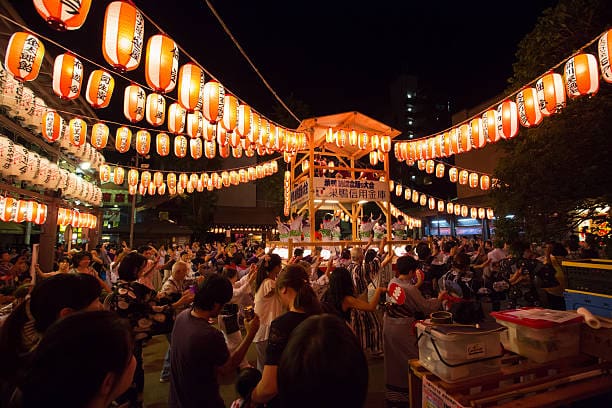
Obon (お盆) occurs during the seventh lunar month. It is said that spirits return to their family homes during this festival, and the living welcome their loved ones back. Families clean graves, offer food at house altars, and perform Bon Odori (a set of traditional dances). At the end of Obon, floating lanterns are put into rivers, lakes and seas to guide the spirits back into the afterlife. People are advised not to spend time with friends before or after Obon, as it is seen as an event to be spent with one’s family. Alongside this, weddings and other joyous occasions are avoided during the 3-4 day festival.
- Fantasy Coffins – Ghana
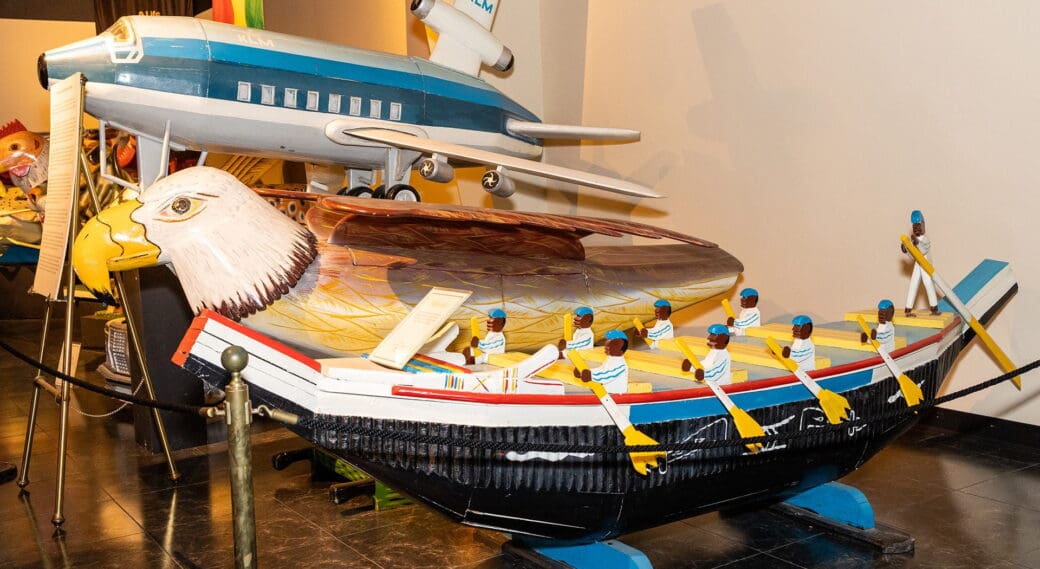
Coffins are normally the same hexagonal shape across the world, meant to match the shape of a human body, make a body easy to transport, and use materials efficiently. But in Ghana, coffins are a way to shape out a life well lived. Coffins here are carved into elaborate shapes reflecting the deceased’s life, such as fish, cars, aeroplanes, and even mobile phones. This way, death becomes a final statement of who the deceased were, what their status was, and what their life meant to the people around them. This is mainly due to the beliefs of the southern Ghana-based Ga people, who believe that life continues in the next world in the same way it did on Earth.
If you’d like to read more about Fantasy Coffins, click me!
- Janazah – Saudi Arabia
Burial in an Islam funeral happens quickly, ideally within 24 hours after death. The body is washed in a ritual cleansing called ghusl, and then wrapped in a plain white cloth known as a kafan with no elaborate coffin in many traditions. The Janazah prayer is then performed by the community rather than limited to family, and is conducted to seek pardon and mercy for a deceased Muslim. Then the body is buried facing Mecca, considered to be the birthplace of Islam. Grave markers are simple rather than ornate, reflecting equality in death no matter the status of the deceased. Cremation is generally forbidden in Islam, as it is seen as severe disrespect and an act of mutilation against the human body, often compared to harming a living person. In Islam, death is seen as a transition rather than something to be staged. Thus, the emphasis on humility is a submission to Allah (God) rather than a ceremony or display.
- Shǒu Sāng (守喪) – China
Chinese funeral traditions differ across the world, whether it be in China or Southeast Asian countries with Chinese populations. But all traditions focus on Xiào (孝), or filial piety, which dictates deep love and profound respect for one’s parents and elders. The body is typically cremated and ritual offerings to the dead are given. This includes burning incense, paper money, and symbolic goods like houses and cars made of paper. This comes from the Chinese folk religion belief that those in the afterlife still need material support. Whether it be a Taoist priest or Buddhist monks, ritual specialists are involved to guide the spirit and ensure a safe transition. After death, practices like memorial rites on the 7th, 49th, and 100th days after death are widely conducted, especially in communities influenced by Buddhism. This is so the family can help the deceased’s spirit pass onto the afterlife and transition smoothly.
- Antyesti – India
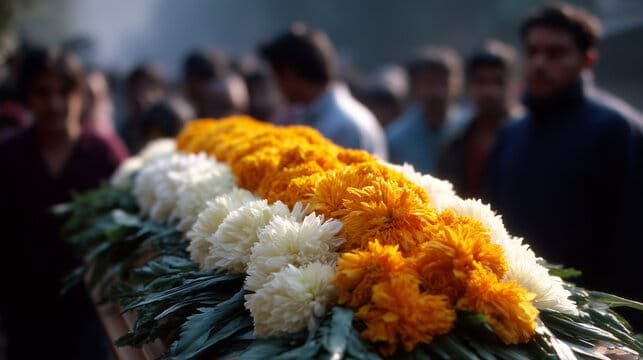
Hinduism’s Antyesti translates literally to ‘last sacrifice’, and the rituals performed during these funerals are designed to purify the body, release the soul, and aid one’s journey to the afterlife. The body is washed, dressed and then adorned with flowers and a priest (often a Brahmin) may guide the rituals. The body is typically cremated and not buried, in order to free the soul from its body. The eldest son or closest male relative lights the funeral pyre, as to set one’s ancestors on the path of nirvana is seen as one of the eternal duties of a son. The ashes are then collected and later scattered in a sacred river – in India, this is often the River Ganges. In the mourning period, pinda daan (ritual offerings) are made to help guide the soul on its journey. In Hinduism, death is not an end but rather a step in the cycle of birth known as Samsara, and these rituals help the soul move on peacefully to its next life.
- Maōri Tangihanga – New Zealand
This is seen as one of the most emotionally rich mourning practices in the world, and there is no such thing as solemn silence in a tangihanga. The main purpose is to exhaust one’s grief and celebrate life, whether it be the dead’s life or appreciating the time the living have. The body is taken to a marae (tribal meeting ground) and the deceased lies in an open casket, often for several days before being buried. The community supports the family of the deceased, and they gather continuously to speak, sing, cry, and share stories. Whaikōrero (formal speeches of remembrance) are carried out, and these speeches are only performed at important gatherings. Women often lead tangi (wailing or lamenting) as an expression of grief. Then, the burial takes place followed by a final farewell feast. Tangihanga is ultimately performed openly and communally, and the dead are actively spoken to as part of the living world during the mourning period.
- Jazz Funerals – New Orleans, USA
New Orleans is often known as the ‘Cradle of Jazz’, largely because it was the only place in the world where African rhythms, blues, and European brass band marches could collide. Since this beloved place is so well-known for this cultural melting pot of music, it’s no wonder why some from New Orleans choose to have a jazz funeral for their final send-off. At first, a procession begins with slow and mournful music filling the streets. The marching band walks in time slowly with the music, and then the rhythm transitions into upbeat jazz as the coffin is escorted to the burial grounds. This symbolises the shift from somber grief to an ultimate celebration of life, and is a poignant yet beautiful way of celebrating the dead while keeping things respectful.
Watch here for a demonstration of a jazz funeral:
- Jhator – Tibet and inner Mongolia
Known as Tibetan sky burials, jhator is a sacred Buddhist tradition where the deceased’s body is dismembered and left on a mountain to be consumed by scavenging animals. The majority of Tibetan people (and many Mongols) adhere to teachings of the transmigration of spirits. In this sense, there is no need to preserve the body as it becomes a vessel upon death. Interestingly enough, these practices could also come from practical considerations as burial and cremation are both impractical for Tibet’s location. Most of Tibet is above the tree line and the lack of timber makes cremation unreasonable, while solid dock or permafrost underlies the surface rather than loose dirt. Ultimately, this tradition is the face of impermanence, and puts focus on the idea that the body returns to nature while the soul continues its journey onward.
- Hanging Coffins – Philippines
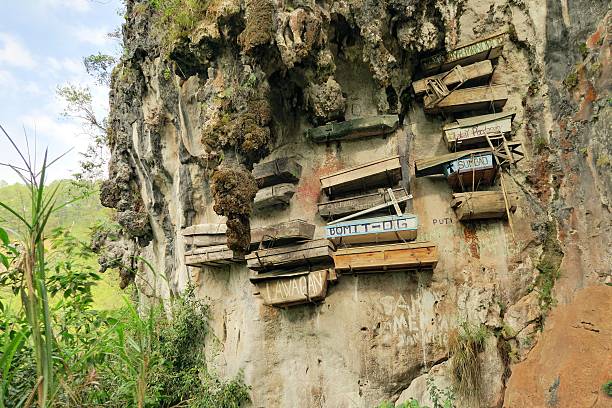
The native people of Sagada follow a unique burying tradition rooted in spiritual elevation, protection, security, and preservation. The elderly carve their own coffins out of hollowed logs, unless they are too weak or ill. The funeral then begins with a gathering, followed by days of mourning, butchering of livestock, and preparing the body for entombment. Then, a family member will carry the body to the rocky cliffs of Sagada’s Echo Valley where the coffin awaits, suspended in the air. It is believed that carrying the dead transfers luck, blessings, and talents to the family. The deceased’s coffin will likely be placed near their ancestors’ coffins, and the higher the coffin, the closer the deceased will reach the spirit world.
- Famadihana – Madagascar
In Madagascar, death is not seen as a clean break between the living and the dead. During Famadihana, or ‘the turning of the bones’, families open ancestral tombs every few years to honour relatives who have passed away. The remains are carefully removed and wrapped in fresh silk shrouds known as lamba mena. Family members may carry the bodies above their heads and dance to live music. In some cases, they speak directly to their ancestors and share family news, introduce new children, and ask for blessings. After the ceremony, the deceased is returned to their tomb with renewed respect and bonding with their loved ones. This is seen as a joyful reunion rather than something morbid, and reinforces the bonds between the living dead. To participants of Famadihana, it is ultimately an act of life – a reminder that family relationships continue long after death.
- Rambu Solo – Toraja, Indonesia
For the Toraja people, death is not immediate. After someone’s death, they could remain in the family home for months or even years. During this time, they are referred to as makula (someone who is ill) and family members may continue to speak to them, bring food, and include them in daily life. The funeral only takes place once relatives have gathered and enough money has been saved to host it, and lasts several days while involving hundreds of guests. The ceremony includes ritual speeches and prayers, traditional music and dance, large communal feasts, water buffalo and pig sacrifices, and processions carrying the coffin to the burial site. Water buffalo are believed to help carry the soul to the afterlife, and the number of those sacrificed can reflect the family’s status and devotion. After the ceremony, the deceased may be placed in a cliffside tomb, cave, or stone chamber. This treats dying as a social process, unfolding over time and only concluding when the community comes together to honour the dead.